January 15, 2025
Turning a brilliant idea into a successful product is one of the most challenging journeys an entrepreneur can embark on. The path from concept to market-ready product is filled with decisions, challenges, and opportunities. This comprehensive guide will walk you through the essential steps of building your Minimum Viable Product (MVP) and setting your startup on the path to success.

An MVP, or Minimum Viable Product, is the simplest version of your product that can be released to early adopters. It contains only the core features necessary to solve a specific problem for your target users. The goal isn't to create a perfect product, but rather to validate your business hypothesis as quickly and cost-effectively as possible. By launching an MVP, you can gather real user feedback, test market demand, and iterate based on actual usage data rather than assumptions.
Building an MVP offers numerous advantages for startups. First, it significantly reduces development time and costs by focusing only on essential features. Second, it allows you to test your product-market fit before investing heavily in development. Third, early user feedback helps you understand what features truly matter to your audience. Finally, an MVP enables you to start generating revenue or attracting investment sooner than a full-featured product would.
Start by articulating the specific problem you're solving and who experiences it most acutely. A vague problem statement leads to a vague product. Talk to potential users, understand their pain points in their own words, and validate that the problem is worth solving before building anything.
Your MVP isn't for everyone — it's for your early adopters. These are the people who feel the problem most intensely and are actively looking for solutions. Define them specifically: their role, industry, daily workflow, and what they're currently doing to work around the problem.
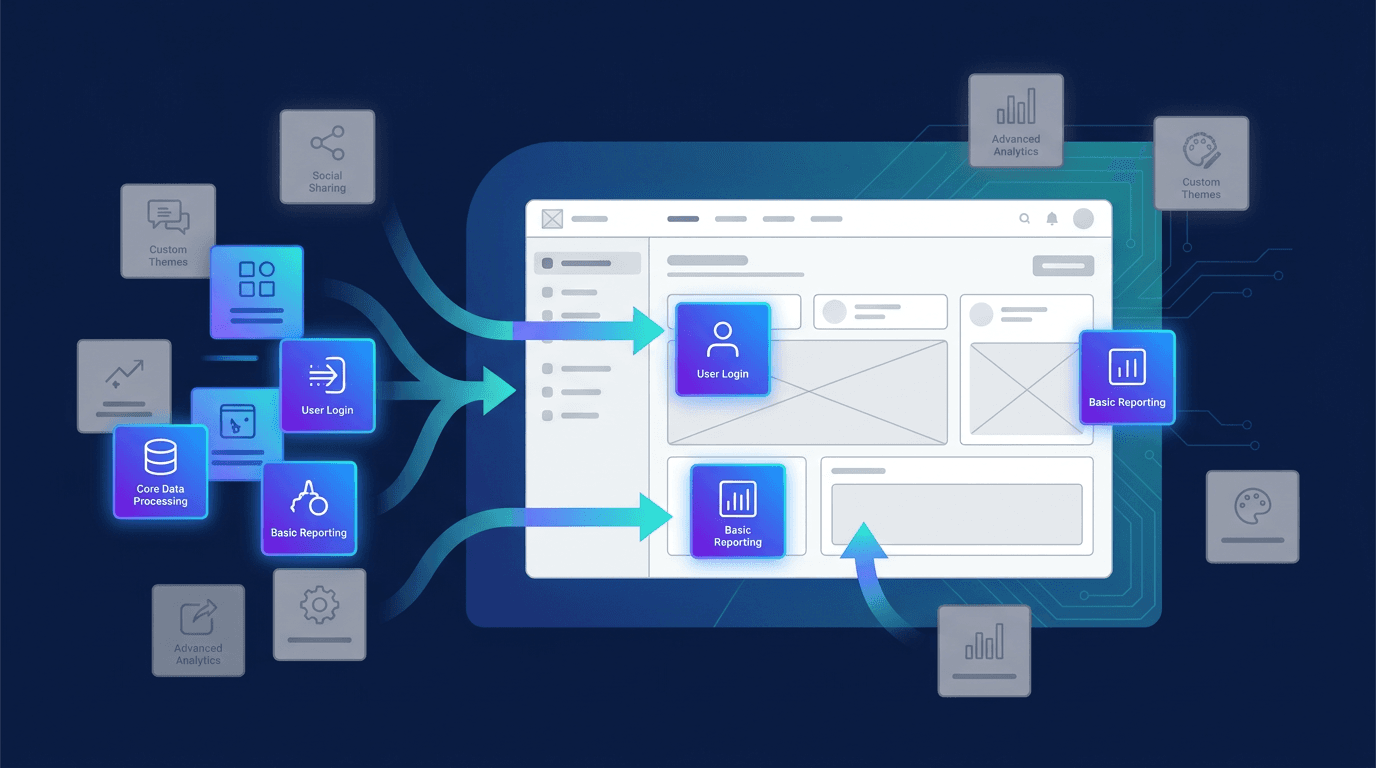
List every feature you can think of, then cut 80% of them. Your MVP needs only the features that directly address the core problem for your target users. Everything else — nice UI, advanced settings, integrations, admin panels — goes in the “later” list. The discipline to say no is what separates successful MVPs from products that never ship.
Build the minimum feature set, deploy it, and put it in front of real users as quickly as possible. Then listen. Track how they use the product, what they ask for, what confuses them, and where they drop off. This feedback loop is the most valuable output of your MVP — it tells you what to build next with confidence.
“The goal of an MVP is not to build a product with fewer features, but to build the smallest product that delivers maximum value to your users and validates your business concept efficiently.”
Successfully launching an MVP is just the beginning of your product journey. After release, focus on collecting and analyzing user feedback, monitoring key metrics, and continuously improving your product. The most successful startups are those that can quickly adapt based on real-world insights and remain committed to solving their users' problems effectively.
We help founders go from idea to launched MVP in 4-8 weeks. 15+ MVPs shipped. $2.4M+ raised by our founders.
Book a Free Discovery Call