
Qwen3.8-Max: Alibaba Open-Sourced a 2.4T Model and Priced It Like a Closed One (2026)

By Surya Pratap
August 6, 2026
12 min read
AI & Technology

August 6, 2026
12 min read
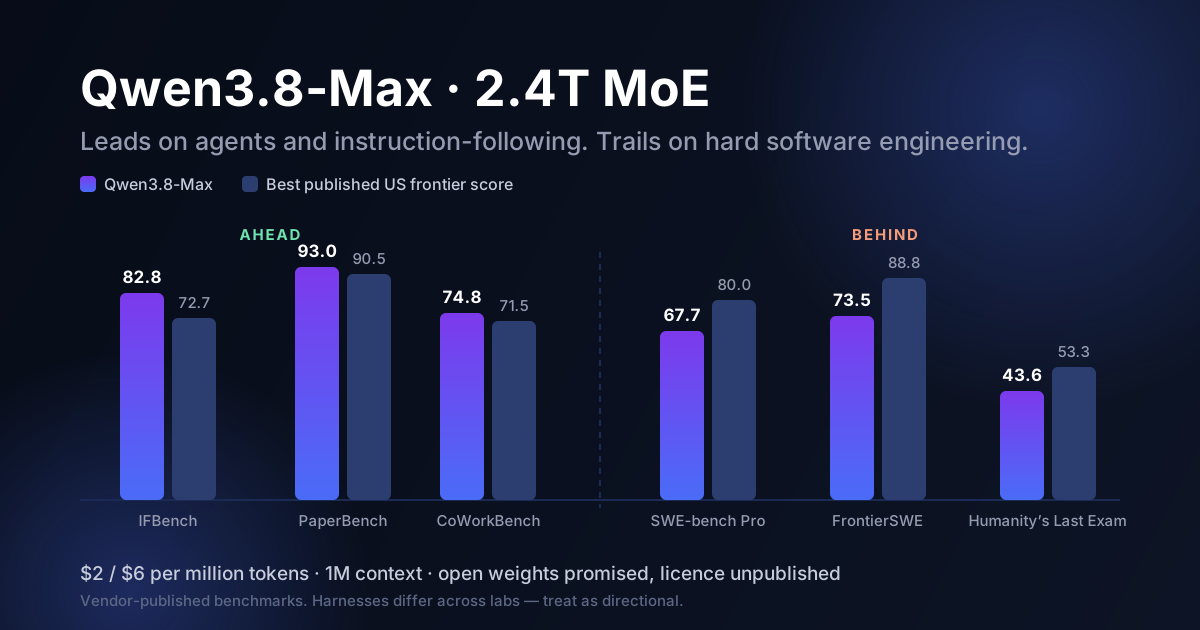
On August 3, Alibaba released Qwen3.8-Max: 2.4 trillion total parameters, 95 billion active per token, a one-million-token context window, text and image and video in. It is the largest model the Qwen team has ever shipped, and it is the first Max-class Qwen that Alibaba has said it will open-source.
Two details are more interesting than the parameter count. The first is the price: $2 per million input tokens, $6 per million output. That is not a discount. That is roughly what US closed labs charge, from a company whose entire competitive story for two years has been undercutting them. The second is that as of this writing the weights are not on Hugging Face and no licence text has been published — the announcement said “next week.”
Both of those tell you more about what to do next than the benchmark table does. Here is the honest read.
Qwen3.8-Max is a sparse mixture-of-experts model: 2.4T total, ~95B activated per token, which is why it can be served at a price that looks nothing like its size. The context window is 1M tokens — 991K maximum input, dropping to 983K with reasoning on, 131K maximum output, and a reasoning budget that can run to 262K tokens. Inputs are text, image and video; output is text only.
The API is available immediately through Alibaba Cloud Model Studio and QwenCloud, speaking both OpenAI-compatible and DashScope formats, with Anthropic-protocol compatibility as well. Published rate limits are generous: 2M tokens per minute, 15K requests per minute. Function calling, structured outputs, batching, prefix completion and fine-tuning are all supported, alongside five built-in tools — code interpreter, web search, web extractor, and image-to-image and text-to-image search.
Caching is where the pricing gets interesting. Implicit cache reads are $0.25 per million tokens, an eighth of the miss price. Explicit cache creation runs $2.50 with reads at $0.17. For an agent that replays a large stable prefix every turn, that is the line item that decides whether a workflow is affordable.
A second checkpoint, Qwen3.8-27B, was announced alongside it and is also slated for open weights. It has no spec sheet, no benchmark table and no pricing yet. Hold that thought — for most people reading this, the 27B is the release that matters, and it is the one we know least about.
Alibaba published a wide comparison set. Read it as two different stories, because that is what it is.
| Benchmark | Qwen3.8-Max | GPT-5.6 Sol | Claude Fable 5 |
|---|---|---|---|
| IFBench (instruction following) | 82.8 | 72.7 | 63.5 |
| PaperBench | 93.0 | 90.5 | — |
| CoWorkBench | 74.8 | 71.5 | — |
| WorkSpaceBench | 67.7 | 65.6 | — |
| GPQA Diamond | 92.6 | — | — |
| OmniDocBench 1.5 | 92.1 | — | — |
| Terminal-Bench 2.1 | 86.6 | 88.8 | — |
| SWE-bench Pro | 67.7 | — | 80.0 |
| DeepSWE 1.1 | 56.6 | — | 70.0 |
| FrontierSWE | 73.5 | — | 88.8 |
| Humanity's Last Exam | 43.6 | 47.2 | 53.3 |
| MRCR v2 (long context) | 92.9 | 93.8 | — |
The pattern is clean enough to route on. Qwen3.8-Max leads on instruction following, document understanding, long-context recall, and bounded agentic office work. It trails, by double digits, on hard software engineering and open-ended reasoning — SWE-bench Pro is 12 points down, FrontierSWE 15, DeepSWE 13, Humanity's Last Exam 10.
IFBench deserves a second look, because it is the most under-rated number in the table and the one that most directly touches production reliability. 82.8 against 72.7 and 63.5 is not a marginal lead. Instruction following is what decides whether your JSON schema comes back valid, whether the model stops when told to stop, whether the tool call is shaped the way your harness expects. A ten-point edge there shows up in your error rate before it shows up in any capability demo.
The colourful results are colourful. In a 365-day simulated e-commerce benchmark the model finished with ¥416,252, roughly 38% ahead of GLM 5.2 and more than double what Qwen3.7-Max managed. In a chip-design task it reduced a cryptographic accelerator from 8,298 logic gates to 678, an 81% die-area reduction. Take those as capability demonstrations, not as evidence about your workload.
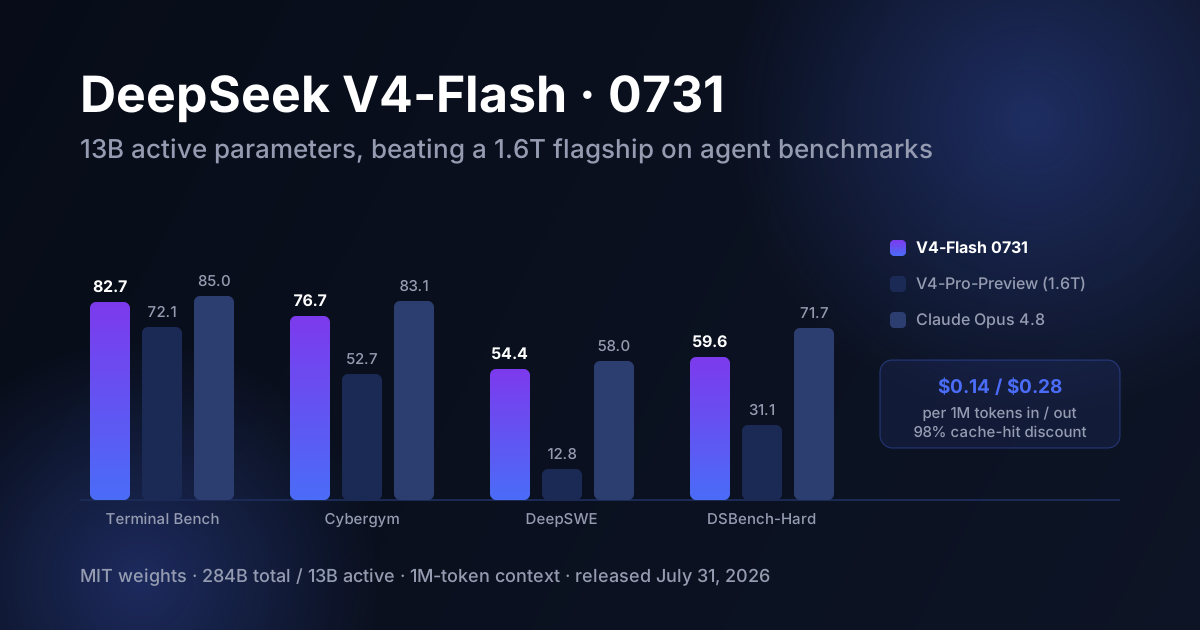
Put Qwen3.8-Max next to what shipped from China three days earlier. DeepSeek's V4-Flash sits at $0.14 input and $0.28 output. Qwen3.8-Max is $2 and $6 — fourteen times and twenty-one times more expensive, from the same broad ecosystem, in the same week.
That is a deliberate positioning move, and it marks a change. For two years the Chinese labs competed on being dramatically cheaper than the frontier. Alibaba has just declined to. It priced at parity with US closed models and let the benchmark table make the argument instead. The bet is that enterprises choosing an agent platform care more about whether the model completes the task than whether it costs a fifth as much.
What this means for your cost model
If you have been assuming “the Chinese open-weights option is always the cheap tier,” that assumption just stopped being reliable. There are now open-weight models at both ends of the price curve, and the label tells you nothing about the bill. Price the specific model against your specific traffic. The one independent data point worth citing here: the Vals Index measured Qwen3.8-Max matching Claude Opus 4.7 at 66.1 versus 66.1 — at roughly 2.3× lower cost per test. That is a real efficiency edge against the closed frontier, and simultaneously nowhere near DeepSeek's economics.
This is the part most coverage glosses. Three things are true at once, and you need all three.
One: the weights are not out. Alibaba promised them “next week” on Hugging Face and ModelScope. As of August 6 nothing has been posted for either checkpoint, and no date has been given. A promised release is a roadmap item, not an asset you can plan against. Precedent argues both ways here — Qwen3.6-35B-A3B and Qwen 4 Coder shipped Apache 2.0 from day one, but Qwen3.6-Plus, Qwen3.7-Max and Qwen3.7-Plus all stayed closed and API-only. This release is the reversal of that second pattern, and reversals are worth confirming before you build on them.
Two: no licence text has been published. Practitioners reviewing the announcement flagged apparent geographic prohibitions covering the USA, EU, UK and Korea, and Alibaba has not clarified. Until the licence file exists you do not know whether you are getting Apache 2.0, a restrictive community licence, or something with territory clauses that make it unusable for your customers. A 2.4T model under a restrictive community licence is still technically “open weights” while changing entirely what you are allowed to ship.
Three: at 2.4 trillion parameters, “you can download it” is close to meaningless for a startup. Serving this model needs a minimum of eight H100- or B200-class GPUs. That is not a laptop, a workstation, or a single cloud instance you spin up to try something. For the overwhelming majority of teams the open weights change nothing operationally: you will use the API, exactly as you would with a closed model. What the weights actually buy is optionality for large enterprises with data-residency requirements, and a base for the distillation and fine-tuning work that will produce the models you eventually run.
Which is why the interesting checkpoint is the 27B. That is the one that runs on hardware a startup owns, the one that can be fine-tuned on your codebase, the one that could matter to your margins. And it currently has no published specification at all. If Qwen3.8 turns out to matter to your business, it will probably be through that model — so watch for the 27B card, not the Max headline.
reasoning_effort among them — without warning and without effect. If your harness sends OpenAI-shaped requests, you may be configuring nothing while believing you configured something. Verify behaviour changes when you change the parameter, do not trust the absence of an error.Given the shape of the evidence, here is what I would actually do.
The temptation with a release this large is to read it as a scoreboard update. It is more useful as a read on where the competition has moved.
For two years the Chinese labs competed on price, and the strategic question for founders was how far the floor would fall. Alibaba just declined to play that game with its flagship. It priced at parity, opened the weights on a model almost nobody can self-host, and pointed the whole release at enterprise agent workloads — office tasks, document processing, long-context work, instruction adherence. DeepSeek is still driving the floor down; Alibaba is competing for the ceiling. Those are different wars and they are now being fought simultaneously.
What that means practically is that the model layer keeps getting more capable at every price point, and keeps getting less differentiating. Qwen3.8-Max will be beaten within a quarter, probably by something in this same family. The routing decision you make this week will be wrong within two. That is not a reason to ignore releases — it is a reason to build so that responding to them is cheap: a gateway instead of a hardcoded SDK, an evaluation set instead of a vibe check, prompts laid out for cache reuse instead of assembled ad hoc.
And it is worth noticing what the benchmark split says about that. The gaps are not in raw intelligence — GPQA Diamond at 92.6 is frontier-class. The gaps are in long-horizon agentic software work, the tasks where the model has to hold a plan across forty steps and recover from its own mistakes. That is the same gap founders hit one level up the stack, when the demo works and production does not. Whichever model you route to, that is still the work that is yours.
IdeaToMVP Academy
4-week live cohort for founders. Learn to ship AI agents, scope MVPs, and automate your business — taught by the same team that writes these guides.