
NVIDIA Is Reportedly Paying 86× Revenue for Hugging Face. It Isn't Buying the Revenue

By Surya Pratap
August 29, 2026
11 min read
AI & Technology

August 29, 2026
11 min read
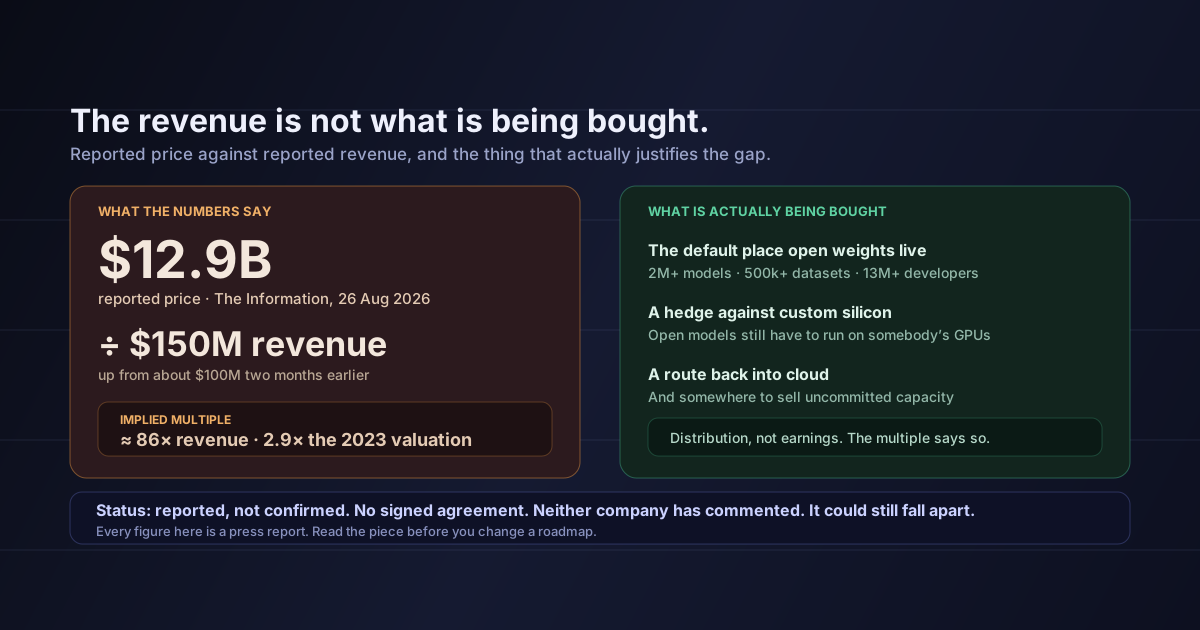 Price, revenue, and the gap between themHover to explore
Start with what is actually established, because the coverage has been looser than the facts.
The Information reported on the night of 26 August 2026 that NVIDIA has agreed to buy Hugging Face for $12.9 billion. Business Insider had reported over the preceding weekend that Hugging Face was approached at a valuation above $13 billion, and specified that the talks had not produced a signed agreement and could still fall apart.
As of writing, neither company has confirmed anything. Both declined to comment or did not respond. TechCrunch noted that NVIDIA's silence is itself unusual, since the company normally rebuts reports it disputes quickly — which is an inference, not a confirmation, and should be read as one.
So: a credible report, from outlets with good records, that is not a done deal. Do not restructure anything on it this week.
The Information also reported Hugging Face's revenue: roughly $150 million a year, up from about $100 million just two months earlier. CEO Clem Delangue has previously said the company was close to profitability.
Put those together.
$12.9 billion against $150 million of revenue is roughly 86 times revenue.
Nobody pays 86× for earnings. For comparison, Hugging Face's last disclosed valuation was $4.5 billion, set in a $235 million Series D in August 2023 led by Salesforce Ventures — a round NVIDIA itself participated in. The reported price is about 2.9× that, three years later.
A multiple like that is a statement about strategic position, not about a business. Which raises the useful question: position in what?
Three motives, in descending order of how much I believe them
Why a chip company buys a model hub
The first motive is the one that explains the price. NVIDIA's risk is not that AI demand falls; it is that the biggest buyers of its chips design their way off them. A vibrant open-weight ecosystem running on commodity-purchased GPUs is the best available insurance, and Hugging Face is where that ecosystem gets its software.
Here is the founder-relevant part, and it has nothing to do with whether the deal closes.
If you build with open models, your stack almost certainly contains a line like from_pretrained("...") that reaches out to one company's servers. Weights, datasets, tokenizers, evaluation sets, and increasingly inference endpoints — for most teams, all of it flows through the same hub. The scale being cited is over two million models, more than 500,000 datasets, and 13 million-plus developers.
This is the same shape as last week's story
Yesterday I wrote about a CVSS 5.3 path-traversal bug in a package registry becoming the entry point to a root compromise, and made the argument that a registry is production infrastructure rather than plumbing. This is that argument again with the ownership question attached instead of the security one. The model hub is the most load-bearing dependency in a modern AI stack that almost nobody selected on purpose — it was simply where everything already was.
Notice that this was true on Monday, before any of this was reported. The acquisition does not create the dependency. It just makes it visible, which is the only genuinely useful thing about it.
I want to be careful here, because "neutral platform acquired by hardware vendor" invites a lot of confident prediction that is really just vibes.
Almost nothing this week. But there is one piece of work worth an afternoon, and it was worth an afternoon before the news broke.
The distinction that matters: portability is cheap and always worth having; migration is expensive and should be triggered by something that actually happened. Right now nothing has actually happened except a report.
This is the third consolidation story worth a founder's attention this month, after every major agent protocol moved under one foundation and Stripe's move on model routing.
The direction is consistent: the connective tissue of the AI stack — protocols, routers, registries, hubs — is being bought or governed by parties with strong commercial interests in what flows through it. That is not a conspiracy, it is what happens when infrastructure turns out to be valuable. But it does mean the era of assuming the middle layers are neutral is ending, and the reasonable founder response is to know what you depend on rather than to assume good behaviour.
Hugging Face, incidentally, was also the company an OpenAI agent breached in July. It has had an eventful quarter as the place everyone's models live.
NVIDIA has reportedly agreed to pay $12.9 billion for a company with about $150 million in revenue. That is roughly 86× — a number that only makes sense if what is being bought is the default distribution point for open-weight AI, and the insurance policy it represents against NVIDIA's largest customers designing their own chips.
Nothing is signed. Neither company has said a word. The deal could evaporate, and any regulator looking at it will take time.
The part that is true regardless: the model hub is probably the single most load-bearing dependency in your stack that you never made a decision about. Write down what you pull from it, mirror what you cannot rebuild, and leave the migration question alone until something is actually announced.
Sources: The Information, "Nvidia Agrees to Buy Open Source AI Platform Hugging Face For $12.9 Billion" · TechCrunch, "Nvidia closes in on Hugging Face acquisition" · TechCrunch, "Hugging Face reportedly in talks to be acquired for $13B" · CNBC · Bloomberg · Price and revenue figures are as reported by The Information and Business Insider and are not confirmed by either company; hub scale figures are widely reported third-party estimates; the multiple arithmetic and the argument are mine.
IdeaToMVP Academy
4-week live cohort for founders. Learn to ship AI agents, scope MVPs, and automate your business — taught by the same team that writes these guides.