Forcing Google's AI Mode Cut Clicks to Websites by 18.8 Points. Users Liked Search Less, Too

By Surya Pratap
October 3, 2026
9 min read
Startup Strategy

October 3, 2026
9 min read
 Fewer clicks, less likedHover to explore
Most of what founders hear about AI search and traffic comes from two places: the platforms that build it, and publishers who say their traffic is collapsing. Neither is an experiment. This study is. It changed what real people saw when they searched, at random, and measured what happened.
Everything here comes from "AI in Search Reduces Publisher Referrals Without Improving User Experience: Experimental Evidence" by Stephanie T. Wang, Jeffrey Gleason, Yakov Bart, Christo Wilson and Danaé Metaxa of the University of Pennsylvania and Northeastern University, posted to arXiv on 18 August 2026 as a draft and widely reported this week. It has not yet been peer-reviewed. The reading from section 4 onward is mine.
The researchers recruited 1,444 people and installed a browser extension that recorded their Google searches, their clicks, and what each results page contained. 1,100 of them searched during the study and form the main sample.
After a three-day baseline, each person was randomly assigned to one of three versions of Google for seven days:
The main outcome was the share of searches that led to a click on an external website.
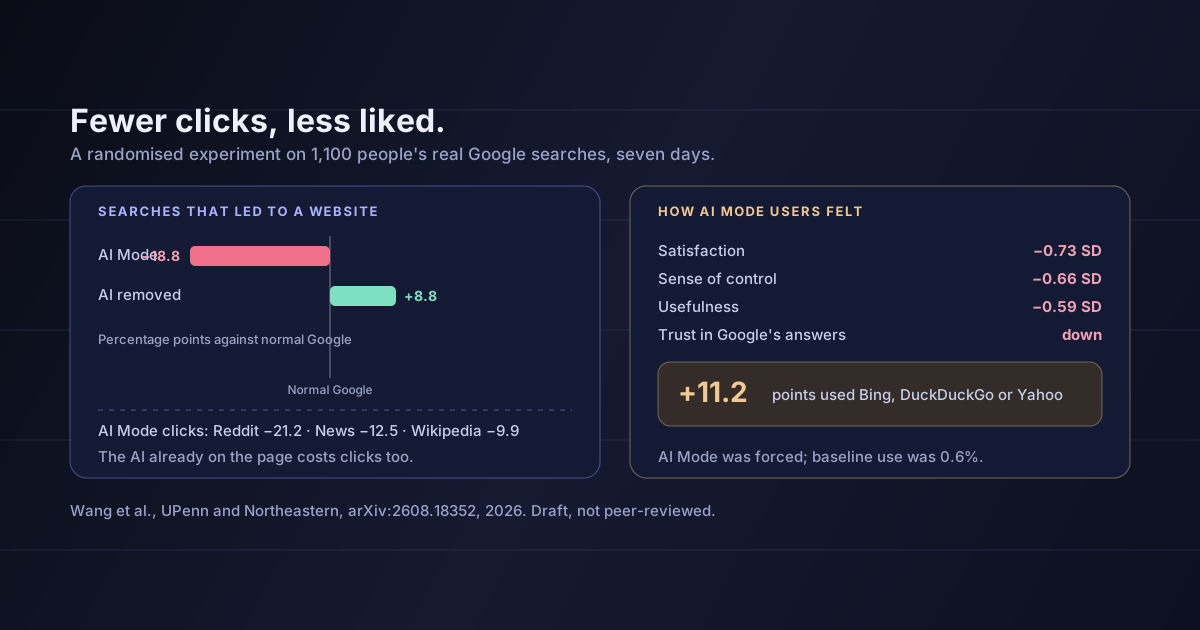
Compared with normal Google, AI Mode cut the share of searches that led to a website by 18.8 percentage points. People in that group also ran 0.92 fewer Google search sessions a day, the opposite of what the researchers expected.
The losses were not evenly spread. Against normal Google, AI Mode cut clicks to:
Clicks on ads fell by 42.7 points, because AI Mode in the study showed none.
The other arm matters more for most founders today. Removing AI from search raised the share of searches that led to a website by 8.8 points compared with normal Google. That is an estimate of what the AI features already on the results page — mainly AI Overviews — are costing websites now, before anyone is forced into AI Mode.
The cost of AI search to your traffic is not a future scenario. The experiment measured part of it in the version of Google people already use.
If AI Mode had made search better for users, lost clicks might have been the price of a better product. It did not.
Against normal Google, people using AI Mode reported:
They also looked elsewhere. The share of people using Bing, DuckDuckGo or Yahoo rose by 11.2 points. In open-ended feedback, about 34% were negative and 29% positive. The most common complaints were losing control of the search and finding it hard to reach a specific site.
For a founder planning distribution, the study says two things that pull in different directions.
AI in search takes clicks. Both arms show it. Full AI Mode took a lot, and the AI already present in normal Google takes a measurable amount.
Users did not want the full version. Before the experiment, participants used AI Mode for just 0.6% of their searches. When forced into it, they were less satisfied, trusted it less and drifted to other engines. That makes it less likely that AI Mode simply replaces ordinary search soon, at least in its current form.
So the realistic near-term risk for most startups is not a sudden switch to AI Mode. It is the steady pressure from AI answers on the normal results page — the 8.8 points — on exactly the informational queries that content marketing is built around.
Give people a reason to click. An answer can be summarised on the results page. A calculator, a template, a live comparison, a free tool or an account cannot. Pages that do something keep their clicks better than pages that only explain something.
Build demand for your name. People in AI Mode complained most about reaching a specific site. Someone searching for your company by name still wants to arrive at your company. Branded demand is the part of search AI cannot easily absorb.
Measure click-through, not just rankings. Split branded and non-branded search, and track the share of impressions that become visits. A stable ranking with a falling click-through rate is what this study predicts for informational pages.
Don't rent your only channel. If one search engine supplies most of your new users, an interface change you do not control can halve that. Email lists, communities, partnerships and product-led referral loops are slower, and yours.
Being cited inside AI answers still matters, and our GEO playbook covers how. But this experiment is a reminder that a citation is not a click, and a business needs the visit.
AI Mode was forced, not chosen. Participants had used it for 0.6% of searches before the study. People who choose AI Mode may behave very differently from people who have it imposed, so the AI Mode effects describe a scenario rather than current behaviour.
It ran for seven days. Short-term reactions to a change in a familiar tool may fade, or grow, over months. The study cannot say which.
The "No AI" arm leaked. Google changed its page code during the study, and the extension's ability to hide AI Overviews fell from about 90% to near zero. The 8.8-point figure is an adjusted estimate that accounts for this, and it is less certain than the AI Mode results.
The sample is not the US population. Participants were younger, more educated and more Democratic-leaning than average. They were consumers searching for themselves, not B2B buyers researching software.
No breakdown by topic. The paper does not report separate effects for health, finance, legal or product searches. Your category could be hit more or less than the average.
It is a draft. The paper has not yet been peer-reviewed.
This is the first randomised evidence most founders will have seen on what AI in search does to traffic. Full AI Mode cut the share of searches that led to a website by almost a fifth, hit Reddit and news hardest, and made people less satisfied with search. The AI already on Google's results page also costs clicks: taking it away gave back 8.8 points.
Users' dislike of AI Mode makes a sudden switch less likely. It does not change the direction. Informational content is getting fewer clicks for the same rankings, and the pages that hold up are the ones that give people something they cannot get from a summary.
Audit which of your pages only explain, and give the important ones a reason to visit. Then build at least one channel that does not depend on a search engine's interface.
Source: Stephanie T. Wang, Jeffrey Gleason, Yakov Bart, Christo Wilson and Danaé Metaxa, "AI in Search Reduces Publisher Referrals Without Improving User Experience: Experimental Evidence", arXiv:2608.18352v1, 18 August 2026 — the three-arm design, the 1,444 enrolled and 1,100 analysed participants, the three-day baseline and seven-day treatment, the −18.8-point click-through effect, the −0.92 daily sessions, the Reddit, news, Wikipedia and ads effects, the +8.8-point local average treatment effect for removing AI, the satisfaction, usefulness, agency, relevance and trust effects, the +11.2-point switching effect, the feedback shares and complaints, the 0.6% baseline AI Mode use, the compliance problem in the No AI arm, the sample description and the stated limitations are all as reported there. The reading in sections 4 and 5 is mine. For how to be cited in AI answers, see our practical GEO playbook. For a channel that does not depend on search, see turning community validation into your first paid customer.
IdeaToMVP Academy
4-week live cohort for founders. Learn to ship AI agents, scope MVPs, and automate your business — taught by the same team that writes these guides.