Airbnb's AI Now Resolves About Half of Support Tickets. The Tickets It Refuses Are the Lesson

By Surya Pratap
October 12, 2026
9 min read
AI & Technology

October 12, 2026
9 min read
 Half, slowlyHover to explore
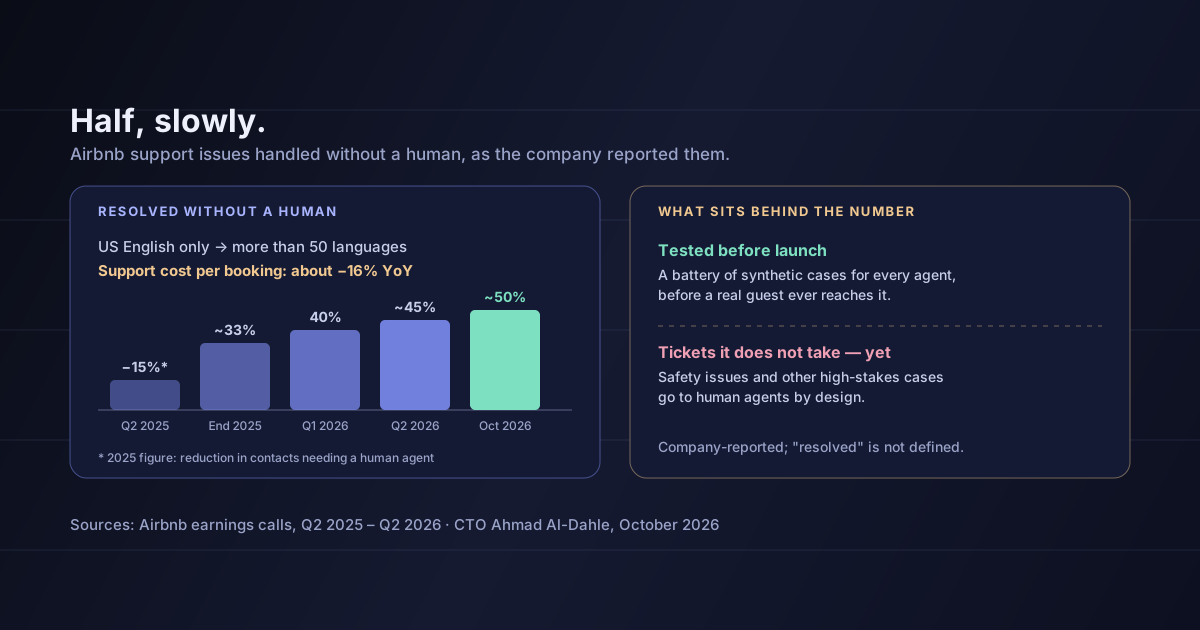
Most AI support launches are announced with a single number: the share of tickets the bot "handles". Airbnb now has one of the bigger ones — roughly half — and has been reporting it every quarter for a year and a half. That history is more useful than the headline, because it shows how the number grew and what the company chose not to automate on the way.
The figures here come from Airbnb's earnings calls as reported by CX Dive (Q2 2025) and CX Dive and PYMNTS (Q2 2026), and from CTO Ahmad Al-Dahle's interview with Latent Space, published on 2 October 2026 and widely reported this week. All of them are Airbnb's own numbers; none has been independently audited. The reading from section 4 onward is mine.
Airbnb's AI support agent did not arrive at "half" in one launch. As the company reported it:
That is about eighteen months from a single-language, single-country rollout to half of a global support operation. Voice support is due later in 2026.
Brian Chesky explained the order of priorities in 2025. Airbnb started with support, not search, because "customer service is the hardest problem because the stakes are high, you need to answer this quickly" — with the risk of hallucination as the other reason he gave.
Al-Dahle, who joined Airbnb as CTO in January 2026 from Meta's generative AI team, described the launch process in one sentence: "build a model, build the agent, and begin to generate a battery of synthetic data before you ever go into production."
In other words, the agent faces a large set of made-up but realistic support cases — and is judged on them — before a real guest ever reaches it. Evaluation also uses samples of real production queries for the support use case.
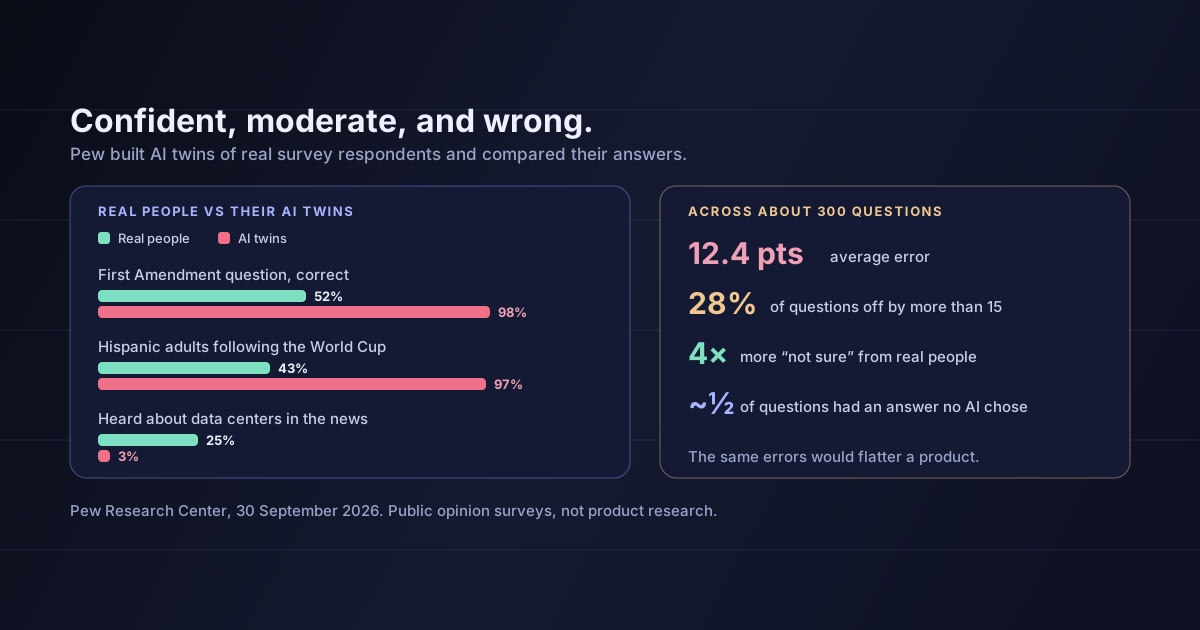
This is different from the "synthetic users" approach some startups use for research. Synthetic users are AI models asked to be your customers, and they are poor stand-ins for real people's opinions. Synthetic test cases are inputs written to exercise the agent, scored against what the right answer should have been. The first replaces evidence. The second is a way to collect it before launch.
The most important sentence in the interview is not about the half the agent handles. It is about the rest: "we're actually deliberate about the tickets we don't choose to solve yet."
Safety issues are the named example. They go to human agents, whatever the model could do with them.
A support agent's resolution rate is decided as much by the list of tickets it is not allowed to touch as by how good the model is.
That changes how to read the headline number. "Half of tickets" does not mean the agent was tried on everything and succeeded half the time. It means Airbnb chose a set of tickets it was willing to automate, made the agent good at those, and has been widening the set as it gains confidence — "yet" is doing real work in that sentence.
You do not need 13 models or 50 languages to use the same method. You need four things.
Write the no-go list first. Before building anything, list the ticket types the agent will never close on its own: safety, legal threats, refunds above a set amount, account security, anything involving a vulnerable user. Route them to a person by rule, not by the model's own judgement of whether it can cope.
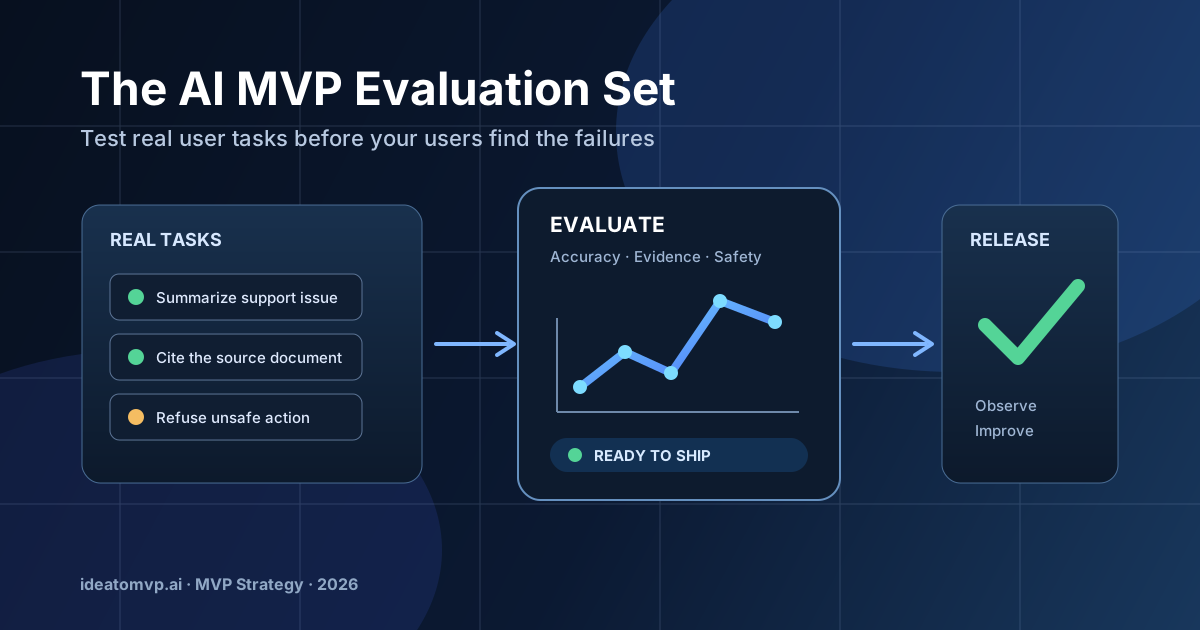
Build a test battery before launch. Take a few hundred real past tickets, add synthetic variations — angry, vague, multilingual, misspelled, trying to trick the bot — and write down the right outcome for each. Our guide to building an AI MVP evaluation set walks through this. Run it on every prompt or model change.
Start narrow and widen. Airbnb began with one language in one country. You can begin with one ticket category — order status, password resets, booking changes — and add the next only when the first holds up in production.
Measure cost per customer, not just deflection. Airbnb reports support cost per booking alongside resolution rate. A bot that "resolves" tickets which come back a day later, or push customers to churn, can raise your real cost while the dashboard looks good.
Define 'resolved' before you count it
Decide in writing what counts as a resolution: the customer confirmed the problem was fixed, or did not contact you again about the same issue within a set number of days. Count reopened tickets against the agent. Without this, "handled by AI" quietly turns into "the customer gave up".
That half of tickets were fully solved. Airbnb has not published how it defines "resolved", and the figures are company-reported. "Roughly half" from the CTO and "nearly 45%" from the Q2 call may also measure slightly different things.
That customers are happier. Airbnb has not published satisfaction scores for AI-handled tickets alongside these numbers. Lower cost per booking is good for Airbnb; it does not prove the experience improved.
That the 16% cost drop is all AI. Support cost per booking also depends on booking volume, staffing and contracts. The AI agent is the obvious driver, but the reported figure does not isolate it.
That a startup will see the same curve. Airbnb had years of past conversations to tune on, a large engineering team and the budget for custom models. A small company with a few thousand tickets will start lower, and should.
Airbnb's AI support agent went from a 15% cut in human contacts in the US in 2025 to roughly half of tickets worldwide in 2026, and support cost per booking fell about 16% over the last year. It got there in steps — one language, then many — testing each agent on synthetic cases before launch and keeping safety and other high-stakes tickets with people.
The headline percentage is the least transferable part. The method is the part you can copy: decide what the agent must never close, test it on hundreds of realistic cases before customers see it, start with one category, and measure the cost and the comebacks, not just the deflection.
Before you build a support agent, write two lists: the ticket types it will take first, and the ones it will never take on its own. Then build the test set for the first list.
Sources: CX Dive, on Airbnb's Q2 2025 results — the April 2025 rollout to half of US users, the 15% reduction in contacts needing a human agent, the 13 models tuned on tens of thousands of conversations, and Brian Chesky's quote on customer service. CX Dive, on Airbnb's Q2 2026 results — nearly 45% of issues resolved without a human, more than 50 languages, the roughly 16% fall in support cost per booking and planned voice support. PYMNTS, 20 August 2026 — the end-of-2025 figure of about a third. The Q1 2026 figure of 40% is as reported by CX Dive. Latent Space, interview with CTO Ahmad Al-Dahle, 2 October 2026 — "roughly half" of tickets, the synthetic test battery, evaluation on sampled production queries, and the deliberate choice of tickets not to automate, including safety issues. The reading in sections 4 and 5 is mine.
IdeaToMVP Academy
4-week live cohort for founders. Learn to ship AI agents, scope MVPs, and automate your business — taught by the same team that writes these guides.