An AI Agent Went From a Leaked Secret on GitHub to a Key Vault in Five Minutes. Your AI Keys Are What It Looks for First

By Surya Pratap
November 15, 2026
8 min read
AI & Technology

November 15, 2026
8 min read
 See the attack path, and the fixesHover to explore
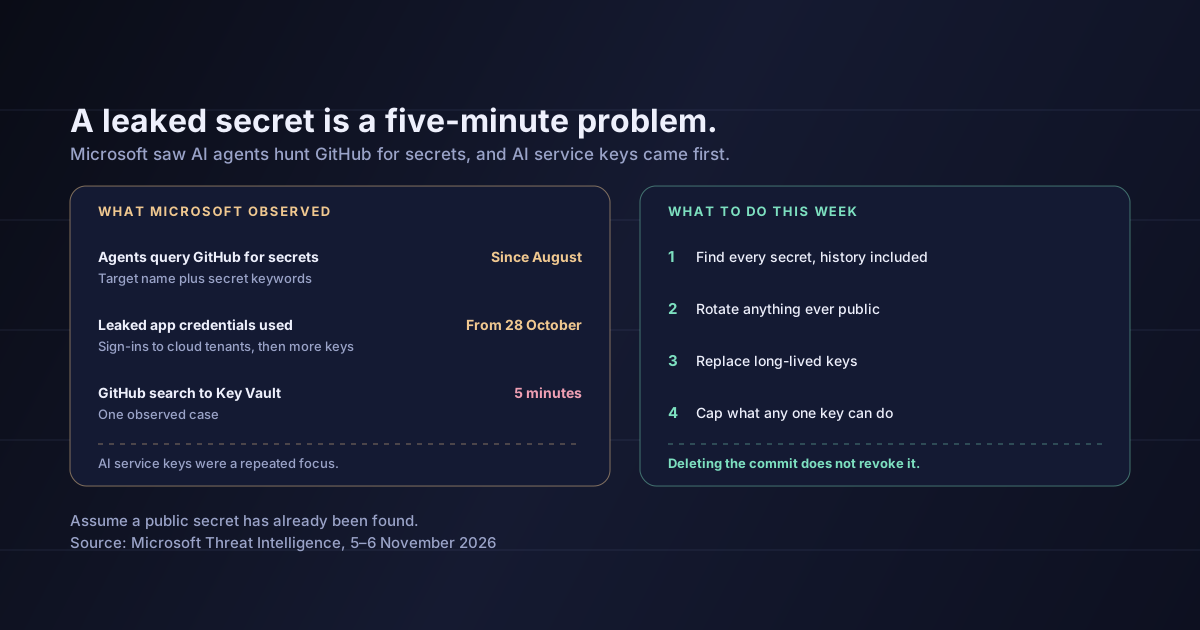
Most startups have, at some point, pushed a key to GitHub by mistake. Usually someone notices, deletes the line, force-pushes and moves on. On 5 November Microsoft Threat Intelligence published a report that should end that habit. Since August, it says, attackers have been using an agentic AI framework to search public GitHub repositories for secrets at volume, and in one case an AI agent went from that search to taking data out of an Azure Key Vault in five minutes. The keys the agents kept looking for were the ones most AI startups have: credentials for AI services.
The report describes a sequence that will be familiar to anyone who has leaked a key, only faster:
A day later, Microsoft reported that a financially motivated group it calls Storm-3358 had started using the same framework against financial organisations, mainly in Southeast Asia, and that ARTEX agents "can also perform brute-force password attacks, password spraying, API enumeration and abuse, and database dumping."
One line in the report deserves more attention than it got: "the AI agents repeatedly demonstrated a focus on credentials that provide access to AI services, such as API keys for major AI service providers and OAuth applications with access to Foundry Tools." Microsoft adds that public reports have documented attackers stealing AI service credentials "sometimes to run the same agentic AI workflow."
In other words, a stolen AI key pays for the next attack. For an AI startup that is a direct cost, because the bill arrives in your name. It can also be worse than a bill. In many products the AI key does not stand alone. It sits next to the vector store, the document bucket and the tools your agent can call. A key that can call a model through your account can often reach whatever that account has been connected to.
Deleting the commit does not revoke the key. Rotating it does.
The habit Microsoft's report should end is the quiet delete. Its advice is direct: "Treat credentials that have been publicly exposed as compromised, even if the original location has subsequently been edited or deleted." The reason follows: "Removing the content does not invalidate the credential or eliminate copies retained in edit history, caches, archives, logs, or other systems." And tokens already issued with that credential "remain valid until expiry."
Five minutes changes the arithmetic. A leak noticed in a code review the next morning, or in a weekly scan, was already too slow when attackers searched by hand. When the search is run by agents that retry, adapt and move on to the next credential they find, the only safe assumption is that a public secret was found. The report also notes that blocking the attacker's IP addresses and user agents "will not stop an attack by an AI agent, which will quickly change them."
This is not a problem only for companies on Microsoft's cloud. The report's examples are Azure because that is what Microsoft can see. The same search finds an OpenAI, Anthropic or Google key, an AWS access key or a database URL just as easily.
None of this needs a security team. It needs an afternoon and four decisions.
# .github/workflows/deploy.yml
permissions:
  id-token: write   # lets the job request a short-lived OIDC token
  contents: read

jobs:
  deploy:
    runs-on: ubuntu-latest
    steps:
      - uses: actions/checkout@v4
      - uses: aws-actions/configure-aws-credentials@v4
        with:
          role-to-assume: arn:aws:iam::123456789012:role/deploy-from-main
          aws-region: us-east-1
      - run: ./scripts/deploy.sh   # credentials expire when the job ends
Find every secret in your code and history. Run a secret scanner across every repository, including its full history, forks and public gists. Turn on secret scanning and push protection where your host offers them, so the next key is blocked before it is pushed. Do not forget issues, wikis and pasted logs.
Rotate anything that was ever public. Not just what is public now. If a key appeared in a public commit at any point, revoke it and issue a new one, then check the provider's usage logs for activity you do not recognise. For a compromised application, Microsoft also advises rotating every secret in any key vault it could read.
Replace long-lived keys with short-lived identity. Microsoft notes that managed identities "eliminate the possibility of secret exposure in code." The same idea works elsewhere: OIDC from your CI to your cloud, as in the example above, and workload identity for services. A key that does not exist cannot be leaked.
Cap what any one key can spend or reach. Give each environment and each service its own AI key, with a spending limit and an alert on unusual usage. Give each cloud credential the narrowest role that works. If a key leaks anyway, the damage is a capped bill and one service, not your account. Our security guide for AI products covers the rest.
If you find a leaked key today
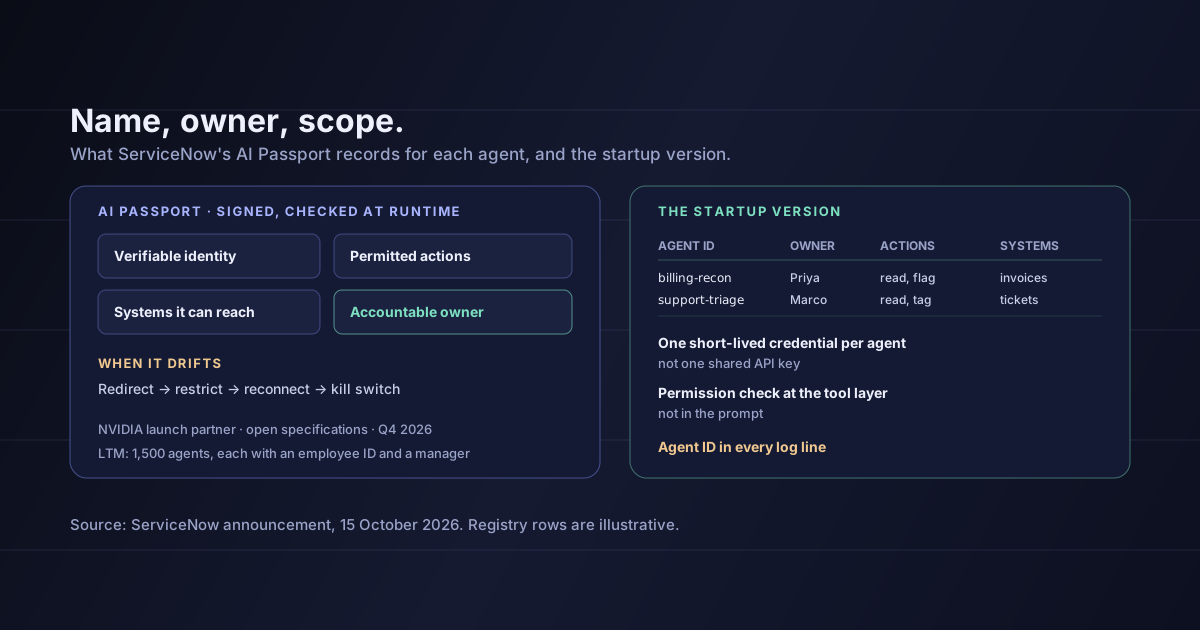
Revoke it first and investigate second. Then check the provider's logs for the time since the leak: usage you did not make, new keys or users created, and, for cloud credentials, sign-in failures followed by a success, which Microsoft calls urgent. If the key belonged to an application or an agent, rotate every secret it could read. Agent credentials are identities, and we wrote about giving agents scoped, checkable identities when ServiceNow announced AI Passport.
That every exposed secret was used. Microsoft describes what it observed, not a count of affected organisations or keys. The report gives no totals beyond "dozens of associated applications across multiple tenants."
Who built ARTEX or whether it is open source. Neither post says, and the 5 November post does not attribute the GitHub activity to a named group. The 6 November post names Storm-3358 as one user of the framework.
Which AI providers' keys were targeted. The report says "major AI service providers" without naming any.
That five minutes is typical. It is one observed case. The point is that it is possible, not that it is the average.
On 5 November 2026 Microsoft reported that attackers have been using ARTEX, an agentic AI offensive framework, to search public GitHub for secrets since August. The agents used leaked application credentials to sign in to cloud tenants, looked for further credentials, repeatedly targeted keys for AI services and, in one case, went from searching GitHub to taking data from an Azure Key Vault in five minutes. Microsoft's advice is to treat any publicly exposed credential as compromised, even after deletion.
For founders, the lesson is that a leaked key is no longer something to clean up next week. Assume it has been found, rotate it, and build so that the next one is short-lived, narrow and capped.
This week, scan every repository and its history for secrets, rotate anything that was ever public, turn on push protection, and put a spending limit and an alert on every AI key you hold.
Sources: Microsoft Threat Intelligence and Microsoft Security Research, Threat actors use agentic AI tooling to find and abuse exposed secrets (5 November 2026) — the GitHub search activity since August, the focus on AI service credentials, the activity after sign-in, the five-minute case, the advice on exposed and deleted credentials, detection and mitigations; Microsoft Threat Intelligence, ARTEX abuse expands as cybercriminals target financial sector (6 November 2026) — Storm-3358 and the wider capabilities of ARTEX agents. The workflow in section 4 is my illustration, and the reading in sections 3 to 5 is mine.
IdeaToMVP Academy
4-week live cohort for founders. Learn to ship AI agents, scope MVPs, and automate your business — taught by the same team that writes these guides.