A general-purpose coding model knows how to write React and Python the way the open internet writes them. It does not know your monorepo's module boundaries, your internal RPC framework, the auth wrapper every service is supposed to use, or the fact that your team banned a pattern three years ago after an outage. That gap — between how the world codes and how your enterprise codes — is exactly what a fine-tuned model closes. And in 2026, building the stack to do it is far more approachable than most engineering leaders assume.
This is a practical, layer-by-layer walkthrough of the stack you need to fine-tune a model on a specific enterprise codebase: the data pipeline, base model selection, the training layer, evaluation, serving, and the retraining loop that keeps the model current as your code evolves. It also covers the decision that comes first — whether you should fine-tune at all, or whether retrieval alone will do the job.
First: Fine-Tuning vs. RAG vs. Long Context
Before you provision a single GPU, be honest about what problem you are solving. Three tools compete here, and they are not interchangeable:
- Retrieval (RAG) teaches facts. "What does this function do? Where is the payment client defined?" If your need is grounding answers in current code and docs, RAG over an embedded index of your repo is cheaper, faster to ship, and updates the instant code changes. Start here.
- Fine-tuning teaches behavior and style. "Write code the way we write it." The naming conventions, the error-handling idioms, the preferred libraries, the house structure of a service — patterns too diffuse to stuff into a prompt and too consistent to leave to a generic model. This is what fine-tuning is uniquely good at.
- Long context handles the one-off. For a single large task, pasting the relevant files into a frontier model's context window is often enough. It does not scale to every developer, every day, at a predictable cost — which is precisely why teams graduate to fine-tuning.
The mature answer is usually fine-tuning plus RAG: a model that has internalized your style and conventions, retrieving your current code at inference time so its facts are never stale. The rest of this guide builds toward that combination.
Layer 1: The Data Pipeline (80% of the Work)
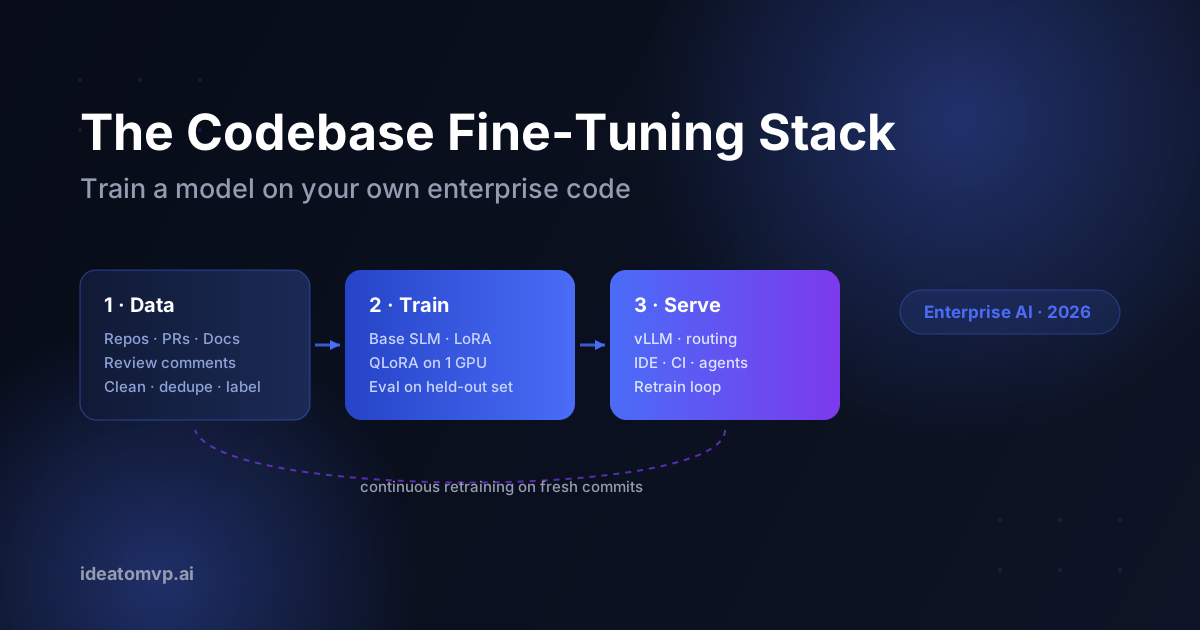
Every honest practitioner will tell you the same thing: the model is easy, the data is the project. A fine-tune is only as good as the examples it learns from, and an enterprise codebase is a messy source. The pipeline has four stages.
- Collect. Pull from the sources that actually encode how your team builds: the source repositories, merged pull requests and their review comments, internal design docs and ADRs, resolved tickets, and runbooks. PRs and review threads are gold — they capture not just the code but the reasoning and the corrections.
- Clean and filter. Strip secrets and credentials (non-negotiable, and do it before anything touches a training server), remove generated code, vendored dependencies, and lockfiles, drop dead and deprecated modules, and deduplicate near-identical files so common boilerplate does not dominate the signal.
- Shape into examples. Decide the task format. For a completion/autocomplete model, use fill-in-the-middle (FIM) examples drawn from real files. For an instruction-following assistant, build instruction–response pairs: "Add a paginated endpoint to this service" paired with the actual diff that did it. PR title + description as the instruction, the merged diff as the response, is a powerful and nearly free source of instruction data.
- Split and hold out. Reserve a test set before training — ideally the most recent commits, so your evaluation mimics real use: predicting code the model has never seen. Never let test files leak into training.
The licensing and privacy gate
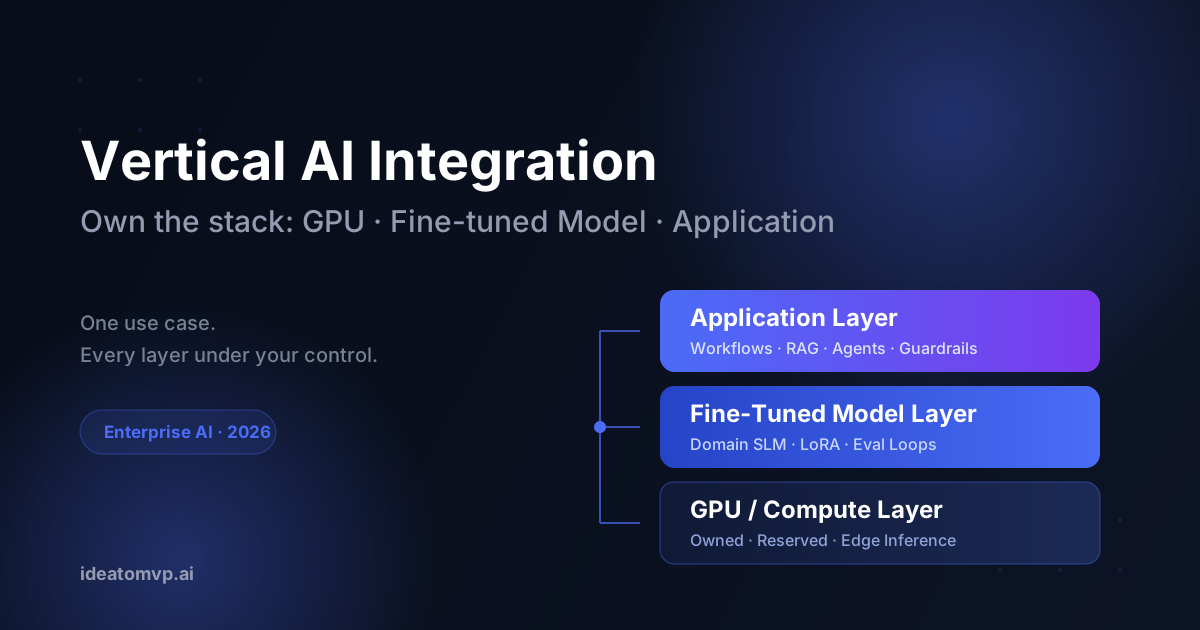
Your training data is your most sensitive IP. This is the single biggest reason to run the whole stack in infrastructure you control — a private VPC, reserved GPUs, or on-prem. Confirm you have the right to train on every source (watch third-party and copyleft code inside the monorepo), scrub PII and secrets, and log exactly what went into each training run. When you own the stack, this becomes an architectural property rather than a vendor promise.
Layer 2: Choosing the Base Model
You are not training a model from scratch — you are adapting a strong open-weight base that already understands programming. Pick from the current generation of open code models (the Qwen-Coder, Code Llama, DeepSeek-Coder, and StarCoder families, plus small general models like Phi and Gemma). Three factors drive the choice:
- Size vs. the job. For inline completion and narrow assistant tasks, a 3B–8B model fine-tuned on your code is fast, cheap to serve, and often beats a much larger generic model on your specific patterns. Reserve 14B–34B for genuine multi-file reasoning. Bigger is not the goal; fit is.
- License. Confirm the weights permit commercial and internal use. This is a legal checkbox, not a detail — clear it before you build on a base.
- Context length and FIM support. Code tasks span files, so favor bases with long context and native fill-in-the-middle training if completion is your use case.
Layer 3: The Training Layer (LoRA / QLoRA)
You almost certainly do not need full fine-tuning. Parameter-efficient methods — LoRA and its quantized cousin QLoRA — train a small set of adapter weights on top of a frozen base, which means you can adapt a 7B model on a single modern GPU in hours, for the cost of a nice dinner. The tooling is mature: libraries like Hugging Face PEFT, Axolotl, and Unsloth wrap the whole loop.
What actually matters in this layer:
- Adapters keep it modular. Because a LoRA adapter is a small file separate from the base weights, you can train one adapter per team, per language, or per service, and swap them at serving time. Retraining is cheap and blast radius is small.
- Guard against catastrophic forgetting. Over-training on a narrow codebase can make the model worse at general programming. Mix in a slice of general-purpose code data, keep learning rates modest, and stop early based on your eval curve — not on a fixed epoch count.
- Track every run. Version the dataset, the base model, the hyperparameters, and the resulting adapter together. When a model regresses, you need to know exactly what changed.
On compute: rent before you buy. A reserved cloud GPU (an A100 or H100 from CoreWeave, Lambda, or a hyperscaler reserved tier) is the right entry point. Only move to owned hardware once training and inference volume are steady enough to justify it.
Layer 4: Evaluation (The Layer Teams Skip and Regret)
A fine-tune that "feels better" in a demo is not a result. The difference between a production model program and a science project is a real evaluation harness that runs on every retrain. For code, you have unusually good options:
- Execution-based tests. Code is checkable. Generate completions for held-out tasks, run them against your actual unit tests, and measure how many pass. Build an internal SWE-bench-style set from your own resolved issues and their tests — this is the most honest signal you can get.
- Style and convention checks. Run generated code through your linters, formatters, and type checkers. A model that has internalized your conventions produces code that passes your CI gates cleanly.
- Head-to-head against the baseline. Always compare the fine-tune against the raw base model and against a strong frontier API on the same task. If it does not beat both on your metric, you have learned something valuable before shipping it.
Layer 5: Serving and the Application Layer
A trained adapter sitting in object storage helps no one. The serving layer is where the model meets developers:
- Inference server. Serve with vLLM, TGI, or Ollama for high-throughput, low-latency inference — critical for autocomplete, where anything over a couple hundred milliseconds feels broken. Quantize (GPTQ/AWQ) to fit more concurrency onto each GPU.
- Retrieval at inference time. Pair the fine-tuned model with RAG over your current repo so it has the style baked in and the up-to-date facts in context. This is the fine-tune-plus-RAG payoff.
- Delivery surface. Expose it where developers already work: an IDE extension for completion, a chat endpoint for questions, a CI bot for review, or as a tool inside an agentic workflow.
- Routing. You do not have to serve every request from your model. Route the high-volume, in-domain requests to your fine-tune and escalate the rare, genuinely hard, open-ended ones to a frontier API. Put each request on the cheapest layer that handles it well.
Layer 6: The Retraining Loop
A codebase is a moving target. The model you train in Q1 is subtly wrong by Q3 because your conventions, dependencies, and architecture have moved on. The final piece of the stack is a loop, not a milestone: on a monthly or quarterly cadence, pull fresh merged PRs into the pipeline, retrain the adapter, run the eval harness, and promote the new adapter only if it beats the incumbent on your metrics. Each cycle widens the gap between your model and anything a competitor can prompt a generic model to produce — because that gap is your accumulated engineering knowledge.
The Stack at a Glance
- Data: collect repos, PRs, docs → clean, dedupe, strip secrets → shape into FIM or instruction pairs → hold out recent commits.
- Base model: an open-weight code model sized to the task, with a clear license and long context.
- Training: LoRA/QLoRA via PEFT, Axolotl, or Unsloth on a reserved GPU, with versioned runs and forgetting guards.
- Evaluation: execution tests, lint/type checks, and head-to-head baselines on a held-out set.
- Serving: vLLM/TGI + RAG, delivered into the IDE, CI, or an agent, with routing to a frontier API for the hard tail.
- Retraining: a scheduled loop that keeps the adapter current as the code evolves.
The Bottom Line
Fine-tuning a model on your enterprise codebase is no longer a research effort reserved for AI labs — it is an engineering project with a well-worn stack: a disciplined data pipeline, an open-weight base, a few hours of LoRA training on a rented GPU, a real evaluation harness, a fast serving layer, and a retraining loop. Get the data right and the rest is plumbing. What you end up with is intelligence no competitor can buy or prompt their way to: a model that writes code the way your organization writes code.
If you are weighing where to start — whether to fine-tune or lean on retrieval, which task to adapt first, or how to stand up the pipeline securely on your own infrastructure — book a free discovery call and we will map the stack with you.
IdeaToMVP Academy
Want to build with AI — not just read about it?
4-week live cohort for founders. Learn to ship AI agents, scope MVPs, and automate your business — taught by the same team that writes these guides.