72% of CIOs Can't Tell If Their Agents Work. 72% Expect Budget Cuts If They Can't Prove It by December

By Surya Pratap
September 25, 2026
10 min read
AI & Technology

September 25, 2026
10 min read
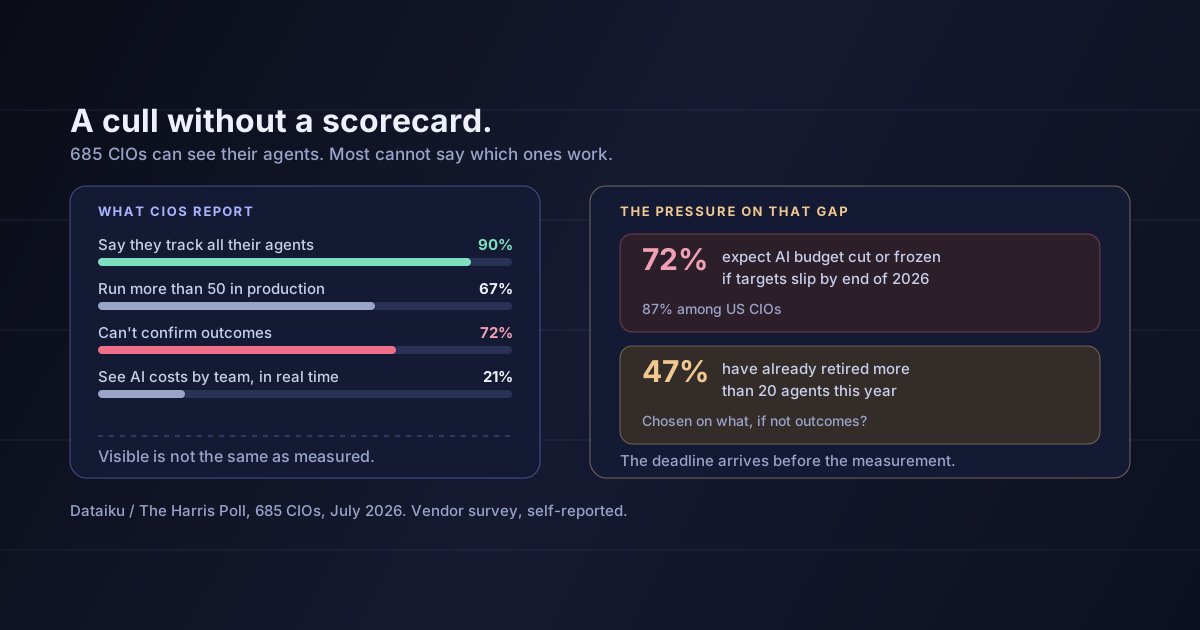 A cull without a scorecardHover to explore
The last few surveys on enterprise agents were about whether companies know which agents they have. This one asks the question that follows: whether they know which ones are worth keeping. The answer is mostly no, and there is a deadline attached.
Figures in this article come from Dataiku's Global AI Confessions Report: CIO Edition 2026, as released on 24 September 2026 and reported by The Next Web and SiliconANGLE. Dataiku launched an agent management product the same day, which matters and is discussed in section 7. The reading from section 4 onward is mine.
The Harris Poll surveyed 685 CIOs online between 9 and 29 July 2026, for Dataiku. Every respondent works at a company with more than $500 million in annual revenue, across eight countries: the US, the UK, France, Germany, the UAE, Japan, South Korea and Singapore.
This is not a survey of early adopters. 67% estimate they have more than 50 agents running in production. These are organisations where agents stopped being a pilot some time ago.
Two findings share a number, and they belong in the same sentence.
Not "have not yet measured ROI in a formal study." Cannot say, on a regular basis, whether the thing is doing the job it was built for.
That is about three months from now. Among US CIOs the figure is 87%.
The pressure above them is uniform. 97% report board pressure for a return on AI. 87% say their CEO has tied their job security to AI outcomes, and 76% believe their role is at risk if the company does not show measurable AI gains by the end of 2027.
Most of these CIOs will be asked to defend an agent portfolio this quarter with evidence they say they do not have.
The survey contains the same contradiction other agent surveys found this month, in a sharper form. 90% say they track all of their agents. 81% say they lack complete oversight of agents created outside approved systems. Both can be true only if "track" means "we know the approved ones exist."
But the more useful gap is a different one. Even for agents they can see, most cannot answer two basic questions:
An agent you can list but cannot score or cost is inventory, not management. Florian Douetteau, Dataiku's co-founder and CEO, put it well enough that it is worth quoting in full: "Monitoring tells you an agent is running. Managing tells you whether it's earned the right to keep running, and right now, almost nobody can fire an agent."
The rest of the lifecycle is missing too
83% lack standardised lifecycle management for agents across the organisation. 60% have no central AI governance layer. 84% agree employees are building agents faster than IT can govern them — 94% in the US. Agents are being created by a process nobody controls and assessed by a process that does not exist.
This is the number I would put in the headline if it were not already long: 47% have decommissioned more than 20 agents this year.
So agents are being fired, whatever the quote says. The question is how. If most organisations cannot confirm outcomes or attribute cost per agent, then decommissioning decisions are being made on something else: which team shouts loudest, which agent broke most visibly last month, which line item finance noticed first.
That is how portfolios get culled when a deadline arrives before the measurement does, and it is not random. Under that kind of pressure, the agents that survive are the ones with the most legible story: a named owner, a number someone can repeat in a meeting, and a cost nobody has to go looking for. An agent that quietly saves forty hours a week and reports none of it looks, on a budget review, exactly like one that does nothing.
Two other findings suggest the next round of decisions will also be about suppliers. 82% of US CIOs regret at least one major AI vendor or platform choice from the last 18 months. 74% are considering open-source or open-weight models as a hedge. The buyers are not only cutting agents. They are reconsidering who they bought them from.
Your renewal will be decided this quarter by a buyer who, on this evidence, probably cannot measure what your product does. Nobody else will produce that evidence, so you need to.
Ship an outcome ledger, not a usage dashboard. Conversations handled and tokens consumed are activity. The buyer needs outcomes: tickets resolved without reopening, invoices matched without correction, hours of a named process removed. Define the unit with the customer at kickoff and count it from day one.
Report cost per outcome, attributed to their org chart. Only one CIO in five can see AI costs by team or use case. If your invoice already breaks down as this team, this workflow, this many outcomes, this cost each, you have done the part of their budget review they cannot do themselves.
Put the off-switch in the contract. Offer explicit retirement criteria up front — if the outcome rate falls below X for two months, we scale down or you exit. It sounds like weakening your position. In a portfolio being culled by visibility, it is what makes you the vendor with a clear answer.
Make portability boring. With 82% of US CIOs regretting a platform choice and 74% hedging towards open-weight models, "can we swap the model underneath without rebuilding?" is now a buying question. Have a short, true answer.
The uncomfortable version of the same point: if your agent's value cannot be expressed in the buyer's own units, you are in the group that gets retired on anecdote, whether or not the agent works.
You do not have 51 agents or a CIO, but the failure mode scales down perfectly. The third agent a team builds is usually the first one nobody can evaluate. A one-line scorecard per agent, kept up to date, is enough:
| Field | What goes in it |
|---|---|
| Owner | One named person, not a team |
| Outcome unit | The single thing it produces that someone would pay for |
| Outcome rate | Last 30 days, counted, not estimated |
| Cost | Model, tool and infrastructure spend for the same 30 days |
| Retirement rule | The number below which it is switched off, written before launch |
Two rules make it work. Write the retirement rule before the agent ships, because afterwards the owner will be too attached to set it honestly. And review the table monthly with the switch-off actually on the table — an agent nobody has ever considered turning off is not being managed, only watched.
This is a vendor survey released alongside a vendor product. Dataiku launched Agent Management — a cross-platform agent inventory and monitoring product, generally available in October 2026, priced per instance and metered by agent — on the same day as the report. A survey that finds agents are unmanaged, published by a company selling agent management, deserves a discount. The Harris Poll ran the fieldwork, which helps; the question design is Dataiku's.
Every figure is a CIO's self-report. "Cannot consistently confirm outcomes" is the respondent's judgement of their own measurement, not an audit of it.
These are large companies. More than $500 million in revenue, in eight countries. The shape transfers to smaller organisations; the percentages do not.
The section 4 reading is mine. The survey does not say how the 20-plus decommissioned agents were chosen. That they were chosen on something other than measured outcomes is my inference from the other numbers, and a plausible one, not a finding.
The external predictions are predictions. The Next Web's coverage cites Gartner's June 2025 forecast that more than 40% of agentic AI projects will be cancelled by the end of 2027. That is a forecast from over a year ago, not an observed rate, and I have not built the argument on it.
Most of the conversation about enterprise agents so far has been about control: which agents exist, what they are allowed to touch, who can stop them. This survey is the first large one that makes the next problem hard to ignore: value. Most CIOs can see their agents, few can say what those agents are worth, and most expect to lose budget if they cannot prove it within three months.
That gap will be filled by someone. Inside a company, it is filled by whoever keeps the scorecard. In a vendor relationship, it is filled by whichever vendor shows up with the numbers already counted in the buyer's units.
If you sell agents, spend this quarter making your product's outcomes countable by the customer — before the customer has to decide without them.
Sources: Dataiku, Global AI Confessions Report: CIO Edition 2026, fieldwork by The Harris Poll, 9–29 July 2026, 685 CIOs at companies with more than $500 million in annual revenue in the US, UK, France, Germany, UAE, Japan, South Korea and Singapore; released 24 September 2026. The Next Web, "'Almost nobody can fire an agent': CIOs and the AI agent oversight gap", Ana Maria Constantin, 24 September 2026 — the full set of percentages used here, including the US breakdowns, the vendor-regret and open-weight figures, the Douetteau quote, and the Gartner reference. SiliconANGLE, "Dataiku debuts cross-platform Agent Management", Duncan Riley, 24 September 2026 — the product launch, availability and pricing model. The reading in section 4 and the recommendations in sections 5 and 6 are mine. For the inventory side of the same problem, see 75% say their agents are secure end to end. For AI add-ons running outside approved channels, see 17,800 AI add-ons take orders from sources nobody verified.
IdeaToMVP Academy
4-week live cohort for founders. Learn to ship AI agents, scope MVPs, and automate your business — taught by the same team that writes these guides.