OpenAI, Anthropic, Alibaba and Hugging Face Just Gave Away Four More Agent Formats. Build Your Agent to the Formats, Not the Vendor

By Surya Pratap
October 26, 2026
7 min read
AI & Technology

October 26, 2026
7 min read
 One neutral format per layerHover to explore
Two months ago, the open question about agent standards was whether the protocols agents use to talk to each other would settle. They did. This week the same foundation took in four more projects, and they cover the parts of an agent that sit inside your own product: the call to the model, the instructions the agent follows, the machine it runs code on, and the environments you test it in.
This article is based on the Agentic AI Foundation's announcement of 22 October 2026 and its posts on each project, and on Unite.AI's coverage. The adoption figures are the foundation's own and have not been independently verified. The reading from section 3 onward is mine.
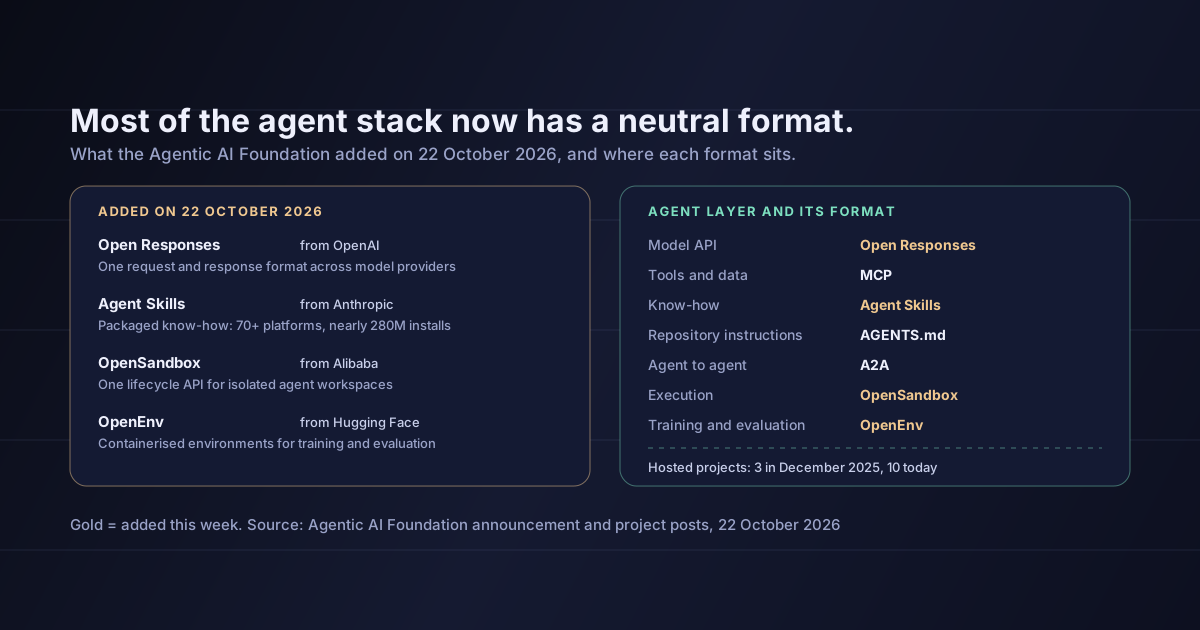
The Agentic AI Foundation (AAIF) is the Linux Foundation body that already hosts MCP, AGENTS.md and A2A. On 22 October, at AGNTCon + MCPCon North America in San Jose, it announced four new projects:
The foundation launched in December 2025 with three projects. It now hosts ten.
Laid out by layer, the list stops looking like an alphabet soup and starts looking like a stack:
The other three, agentgateway, Agent Router and goose, sit around these. The point is not that every layer is finished. It is that for most layers there is now one obvious neutral format, and it is not owned by the vendor whose model you happen to use.
The model API was the one layer every agent touched and no neutral body owned. As of this week, one does.
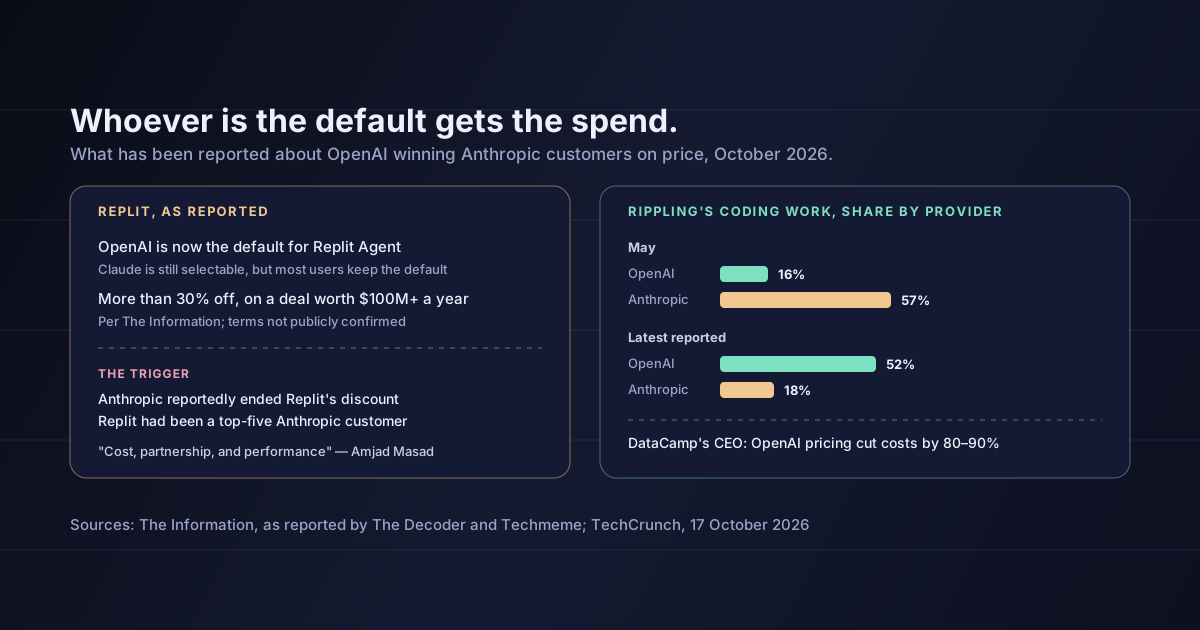
Most early-stage agents are one product glued to one model provider. MCP already made tools portable. What stayed proprietary was the call to the model itself: the request shape, how tool calls come back, the streaming events. That is where the switching cost lives, and, as Replit showed last week, switching cost is what decides whether a price war helps you.
Open Responses targets exactly that. In the foundation's words, with a compliant endpoint "the endpoint and model identifier become configuration". It is not hypothetical: the foundation says Databricks Model Serving already exposes an Open Responses endpoint for Claude, Gemini and open models, translating into each provider's native API, and Vercel AI Gateway exposes one too.
Two cautions. First, the common shape is OpenAI's shape. That is fine for portability, but it means providers with different features reach you through translation, and the foundation itself asks developers to report "where information gets lost". Second, provider-specific features arrive as namespaced extensions, so a prompt that leans on one provider's extension is not portable just because the request is.
Put model calls behind a Responses-shaped interface. Whether you call providers directly or through a gateway, write your agent loop against one request and response shape. Then a second provider is a configuration change and an eval run, not a rewrite.
Write know-how as skills, not as one giant system prompt. A task's instructions, examples and checks packaged as a skill can be versioned, reviewed and reused across agent products. The person who knows the process can maintain it without touching the agent code.
Run agent code in a sandbox you can replace. If your agent runs commands or installs packages, never run it on the host. Wrap sandbox creation and execution behind one interface, so moving from your own containers to a hosted provider, or back, does not touch the agent.
Treat a third-party skill like a dependency. A skill can contain scripts, and installing one gives it the agent's access. Pin versions and review what you install. One company the foundation cites sends every submitted skill through human review before it reaches its agents.
The protocols settled first
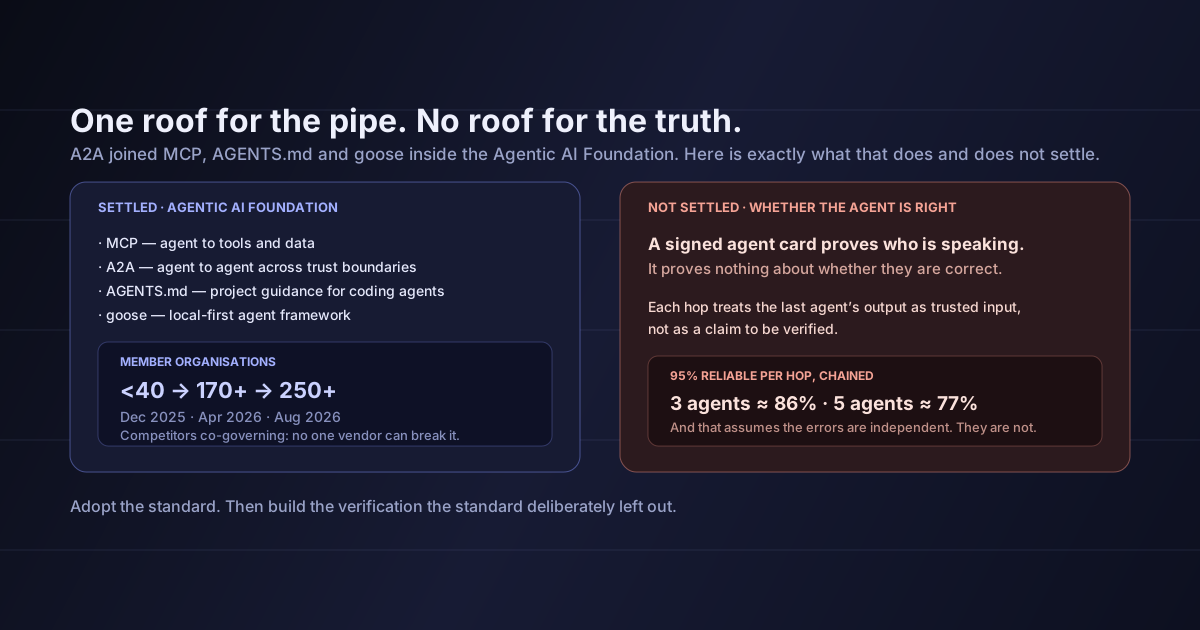
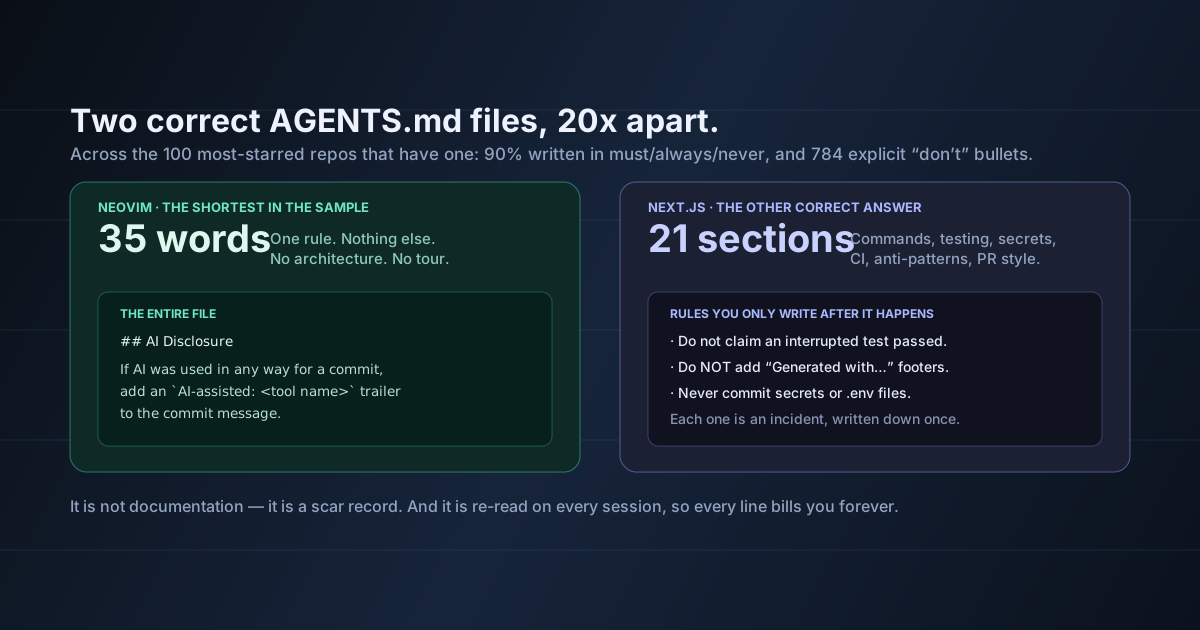
We covered the first wave in August, when A2A joined MCP and AGENTS.md under the same foundation, and why a standard transport says nothing about whether an agent is right. If you already keep an AGENTS.md, see what the biggest repos put in theirs.
That the adoption numbers are audited. More than 70 platforms, 1 million skills and 280 million installs are the foundation's figures. Published skills are not the same as useful ones.
That "neutral" means vendors stop competing. Each project was contributed by a company that benefits if the format spreads. A neutral home changes who governs a format, not why it was offered.
That OpenSandbox makes untrusted code safe. The foundation's post describes the API and the runtimes, not the strength of the isolation. Container isolation is not the same as a separate VM; check what your runtime actually provides.
That you should adopt all ten. A two-person team needs a portable model call, a sandbox if the agent runs code, and an eval set. The rest can wait until a customer or a partner asks for it.
On 22 October, OpenAI, Anthropic, Alibaba and Hugging Face moved Open Responses, Agent Skills, OpenSandbox and OpenEnv into the Agentic AI Foundation, which now hosts ten projects. Together with MCP, AGENTS.md and A2A, most layers of an agent now have a neutral format that no single model vendor controls.
For founders, the useful consequence is cheaper switching. The layer that mattered most for that, the call to the model, is the one that just got a neutral specification. Build to these formats now, while your agent is small, rather than retrofitting them after your own conventions have spread through the codebase.
This month, put every model call behind one Responses-shaped interface and run your eval set through a second provider, move your longest system prompt into a versioned skill, and make sure any code your agent runs goes through a sandbox you could swap out.
Sources: Agentic AI Foundation, 22 October 2026 — the four new projects, their contributors and descriptions, the list of ten hosted projects and the growth from three at launch. AAIF project posts on Open Responses (the shared format, Databricks Model Serving and Vercel AI Gateway support, extensions and information lost in translation), Agent Skills (the platform, skill and install figures and the human-review example) and OpenSandbox (the lifecycle and execution APIs and the Docker and Kubernetes runtimes). Unite.AI — the OpenEnv description and the AGNTCon + MCPCon context. Linux Foundation — the foundation's formation in December 2025. The reading in sections 3 to 5 is mine.
IdeaToMVP Academy
4-week live cohort for founders. Learn to ship AI agents, scope MVPs, and automate your business — taught by the same team that writes these guides.