Meta Says Muse Spark 1.3 Uses 25% Fewer Tokens. Independent Testing Says Your Bill Went Up

By Surya Pratap
September 15, 2026
12 min read
AI & Technology

September 15, 2026
12 min read
 Two cost stories, one invoiceHover to explore
Meta released Muse Spark 1.3 on 2 September 2026, into Muse Code and the Meta Model API. The launch has an efficiency story and a benchmark story, and each one is worth reading twice — not because either is false, but because neither says quite what a founder would reasonably assume.
Muse Spark 1.3, as released
Available today; weights are closed
Two things there are genuinely good news. The 1M context window is large enough that "will it fit" stops being the daily question for most codebases, and holding per-token pricing flat across a capability upgrade is a real concession in a market that mostly does not.
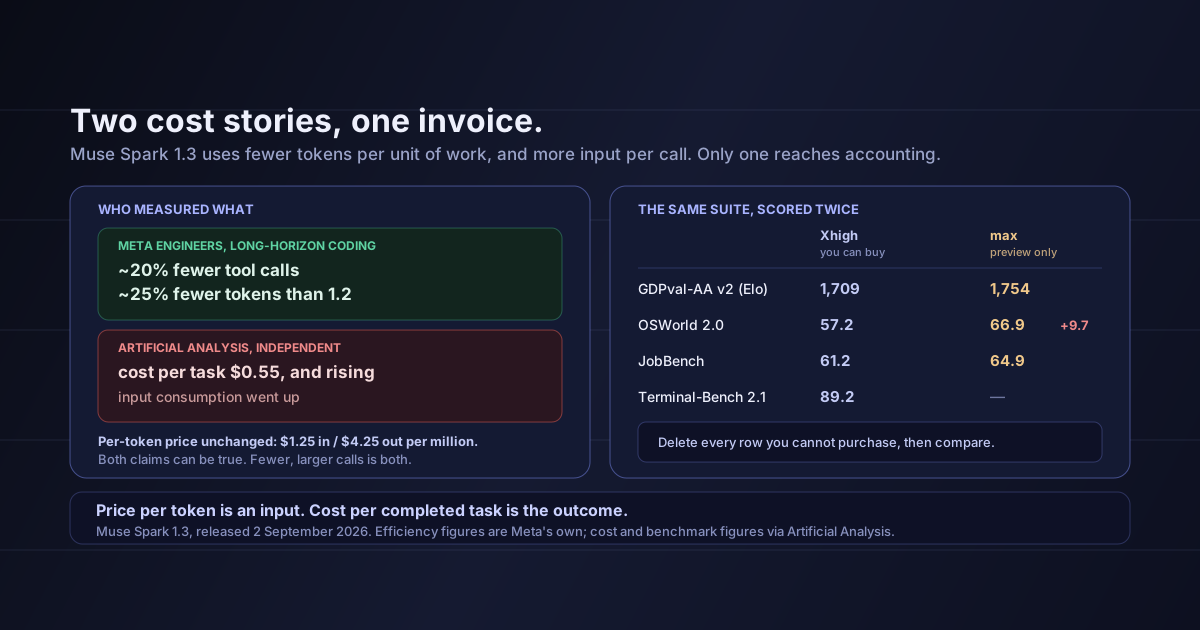
Meta's headline is that 1.3 uses ~20% fewer tool calls and ~25% fewer tokens than Muse Spark 1.2.
The precision matters: those figures come from evaluations by Meta engineers on long-horizon coding tasks. That is a vendor-internal comparison on a vendor-chosen workload — not fabricated, not audited, and not necessarily yours.
Read literally it is also a narrower claim than it sounds. Fewer tool calls and fewer tokens per unit of the work they measured. Whether your bill falls depends on a quantity Meta did not report: how much context each of those remaining calls carries.
Artificial Analysis, testing independently, measured cost per task at $0.55 on the broadly available configuration — and reported task costs going up relative to 1.2 despite the unchanged per-token price, because input-token consumption increased.
Put the two findings side by side and they are not contradictory. They are describing different halves of the same change.
Fewer, larger calls is an efficiency win by one measure and a cost increase by the other. A model that thinks harder per step takes fewer steps and reads more each time.
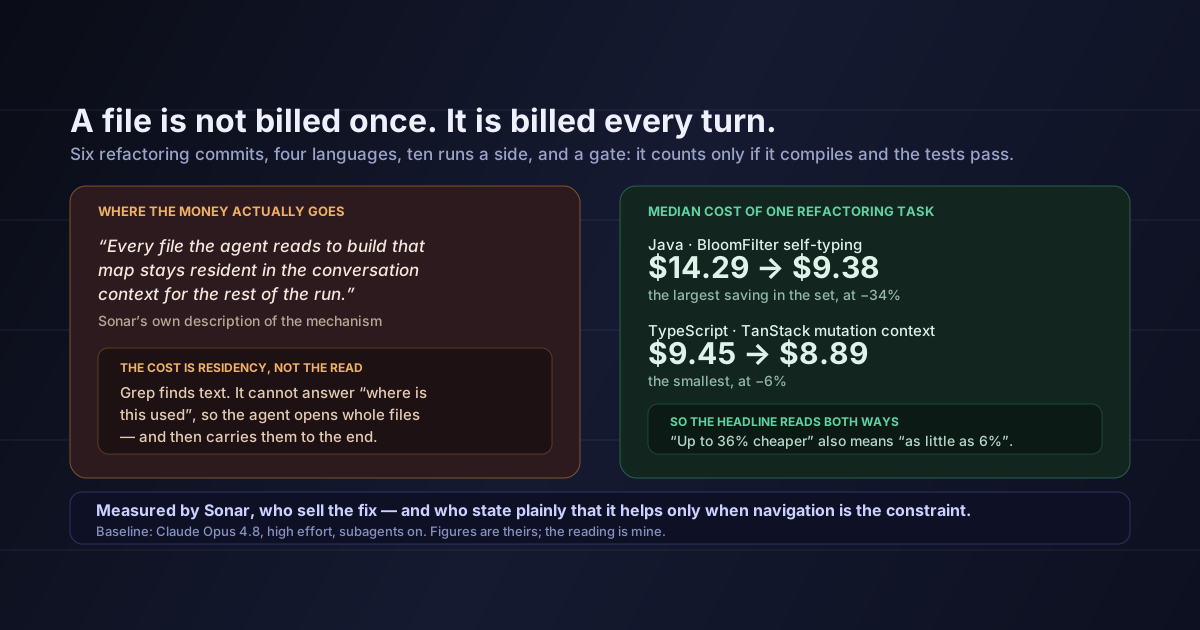
This is the same arithmetic as the context tax. Agentic work bills on what the model reads, not on how many times it stops to think, and a harness that loads more context per call to justify making fewer calls can consume more in total while every headline number improves.
The number to ask for, in any model announcement
Price per token is an input, not an outcome. The only figure that settles a switching decision is cost per completed task on your workload — the whole run, including retries, failed attempts and the context each call carried. Meta reported efficiency ratios; Artificial Analysis reported cost per task. When those two point in opposite directions, the second one is the one that reaches accounting.
This is the part most coverage flattened, and it changes how the scorecard should be read.
Muse Spark 1.3 was evaluated in two configurations. One you can buy today. One you cannot.
The gap is not cosmetic. On OSWorld 2.0 it is 9.7 points — 57.2 against 66.9 — and the max configuration featured prominently in the launch materials while being unavailable to buy.
Nobody is being deceived here exactly; the configurations are labelled. But a founder scanning a comparison table will read the highest number in the Muse column and compare it against whatever they are running today, and that comparison is wrong by roughly ten points on the benchmark that most resembles operating a computer.
Rule of thumb: in any model launch, find the footnote that says which configuration each column was run under, and delete every row you cannot purchase.
The pricing line that deserves the most thought is the one that looks like the best deal.
Standard is $1.25 / $4.25 per million tokens. The contributor tier is $0.10 / $0.20 — around 12x cheaper on input and 21x cheaper on output — in exchange for permitting your data to be used for training.
For a pre-product side project, that is close to free inference and an easy yes. For anything carrying customer data it is a different question entirely, and it is not primarily a cost question:
None of that makes the tier wrong. Meta is being unusually explicit about the exchange, which is more than most discounted inference offers. It just means the decision belongs with whoever owns your data commitments, not with whoever watches the inference bill.
Three points of context, all of them qualified.
Throughput trails. At 235.2 output tokens per second, Muse Spark 1.3 runs roughly 30% slower than Gemini 3.8 Flash. For interactive coding that is felt; for overnight batch work it is close to irrelevant.
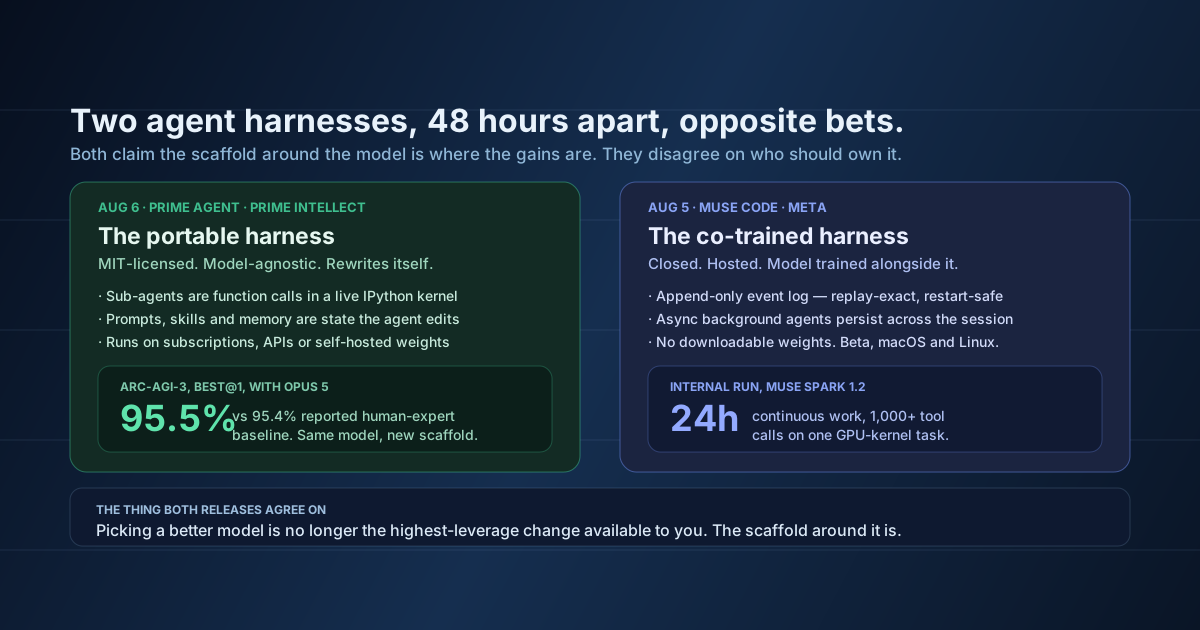
Closed weights, with a roadmap that is not a plan. Meta lists an open-weights Muse Spark release among "bigger models… and more" — no version, no date, no licence terms. If your architecture depends on eventually self-hosting, that sentence is not something to build against. Compare with the harnesses that shipped open in August, where the portability was the product rather than a future intention.
The benchmark spread is genuinely strong where it is strong. Terminal-Bench 2.1 at 89.2, DeepSearchQA at 89.4, long-context retrieval at 98.5 for 256K–512K and 98.1 for 512K–1M. That last pair is the one I would weight most, because near-flat retrieval quality across a 1M window is what makes a large context worth paying for rather than just large.
One disclosure on the numbers: published Terminal-Bench 2.1 figures for 1.3 vary slightly by source — 89.2 in the Artificial Analysis table and 88.8 elsewhere. It is a rounding-level difference with no bearing on any decision, but where sources disagree the house rule is to say so.
If you are running an agentic coding workload today, this is a two-hour experiment rather than a reading exercise.
How I would actually evaluate the upgrade
The comparison has to be per completed task, not per token
Vendor-internal efficiency numbers are not wrong, they are narrow. "Meta engineers measured it on long-horizon coding tasks" is a disclosed methodology and more than many launches give you. It is still their workload and their harness.
One independent cost measurement is also not the last word. Artificial Analysis runs a fixed task suite; your repository is not that suite. The reason to trust the cost-per-task framing is not the specific $0.55 — it is that the metric is the right one.
A max-reasoning configuration in preview is normal. Staged release behind safety testing is reasonable practice, and the frustration here is presentational, not ethical: the numbers were shown in materials aimed at people who cannot yet obtain them.
A version bump is not a migration. 1.2 still works, still costs the same per token, and switching a production agent to a model tuned on different long-horizon behaviour will change how your prompts behave in ways no benchmark predicts.
Muse Spark 1.3 is a real improvement shipped at unchanged per-token pricing into a harness that people already run, with a 1M context window whose retrieval quality holds up across the whole window. That is a good release.
It also arrives with two numbers pointing in opposite directions — fewer tokens per unit of work by the vendor's count, higher cost per task by an independent one — and a scorecard whose brightest column is a configuration nobody can buy yet. Neither of those is scandalous. Both are ordinary, and both are exactly the kind of thing that decides whether your inference bill in November matches the plan you wrote in September.
Price per token told you nothing this week. Cost per completed task, on your own tasks, is the only number that would have.
Sources: Meta AI Research, "Introducing Muse Spark 1.3" · VentureBeat, "Meta says Muse Spark 1.3 has frontier performance — but its best results come from a model developers can't broadly use yet" · MarkTechPost, "Meta AI Released Muse Spark 1.3" · The ~20%/~25% efficiency figures are Meta's own, from evaluations by Meta engineers on long-horizon coding tasks. Benchmark scores, the $0.55 cost per task, the 235.2 tokens/second throughput and the Xhigh-versus-max split are as reported by Artificial Analysis via VentureBeat; the max configuration was in limited partner preview at the time of testing. Where Terminal-Bench 2.1 figures differ between sources it is noted in section 6. The reading of the two cost claims as compatible, and every recommendation, is mine. For the harness this model runs inside, see the two agent harnesses that shipped a day apart.
IdeaToMVP Academy
4-week live cohort for founders. Learn to ship AI agents, scope MVPs, and automate your business — taught by the same team that writes these guides.