
Nine Months Ago Hugging Face Turned NVIDIA Down to Stay Independent. Now It's Reportedly Selling

By Surya Pratap
August 31, 2026
10 min read
AI & Technology

August 31, 2026
10 min read
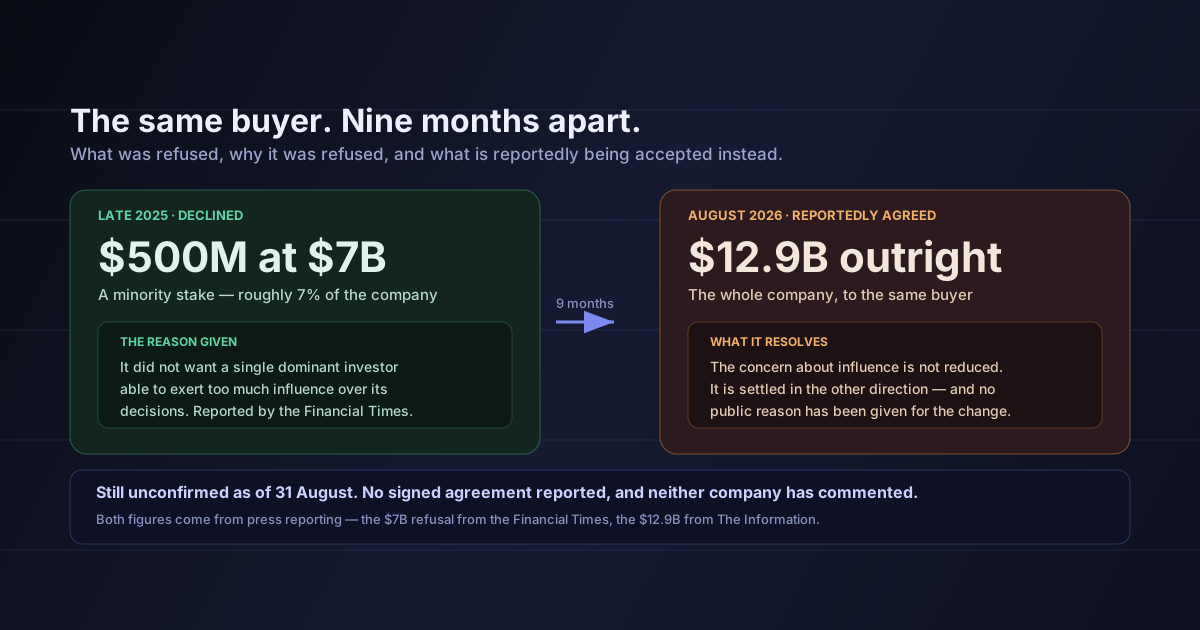 What was refused, and what is reportedly acceptedHover to explore
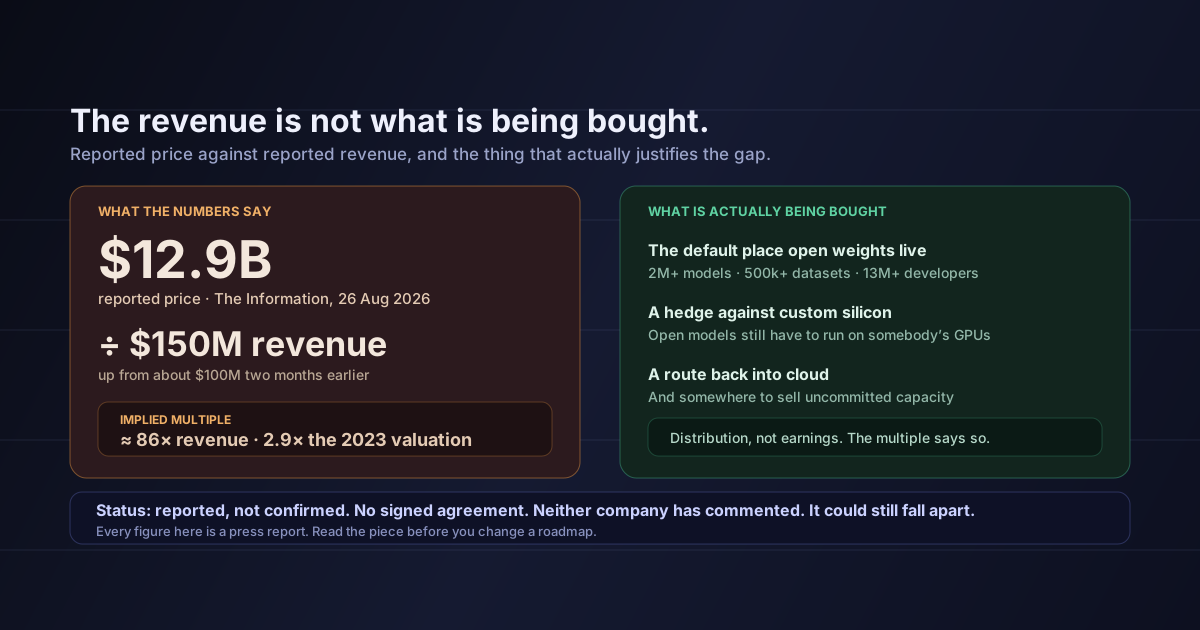
Two days ago I wrote about the reported NVIDIA acquisition of Hugging Face and argued that at roughly 86 times revenue, the asset being bought is distribution, not earnings.
Since then a detail has surfaced that makes the story considerably more interesting, and it is not about the price.
The Financial Times reports that at the end of 2025, NVIDIA offered Hugging Face $500 million at a $7 billion valuation — a minority stake of roughly 7%.
Hugging Face turned it down. The reported reason:
It did not want a single dominant investor who could exert too much influence on its decisions.
That is a coherent position, and for a company whose entire value rests on being the neutral place everyone's models live, it was arguably the correct one. A chip vendor with a board-relevant stake in the main distribution point for open weights is a conflict you can see from space.
Nine months later, the same company has reportedly agreed to sell the whole thing to the same buyer for $12.9 billion.
Be careful with the obvious reading. "They said independence mattered and then sold" is cheap, and it is not quite what happened.
Refusing a minority investor and accepting an acquirer are different decisions with different logics. A 7% holder with influence but no accountability is arguably the worst of both worlds: you carry the conflict without the resources. An outright sale at least resolves the ambiguity — everyone knows who owns it.
But notice what does not survive that reframing. The stated objection was influence over Hugging Face's decisions. The reported deal does not reduce that influence. It settles it completely, in NVIDIA's favour, permanently.
The gap in the story
Nobody has explained the change. Neither company has commented on the acquisition at all, and no public reasoning has been offered for why a company that declined a minority stake on independence grounds in late 2025 would accept a full sale in mid-2026. That gap is the most interesting thing here, and anyone confidently filling it — including me — is speculating.
I can think of four, and they are not mutually exclusive.
Why a company changes its mind about this in nine months
Ordered by how much weight I would put on each
The last one deserves emphasis because it reframes the first three. This is not a hostile acquisition of a reluctant target. It looks like two parties who agree about open models deciding that one of them should own the pipe. Whether you find that reassuring or alarming probably depends on how much you like the pipe being owned at all.
Here is the part that generalises past this deal.
Hugging Face's neutrality was never a structural guarantee. It was a choice, made repeatedly, by people who could have chosen otherwise — and in late 2025 they demonstrably did choose it, at a cost of $500 million. That is more than most platforms can claim.
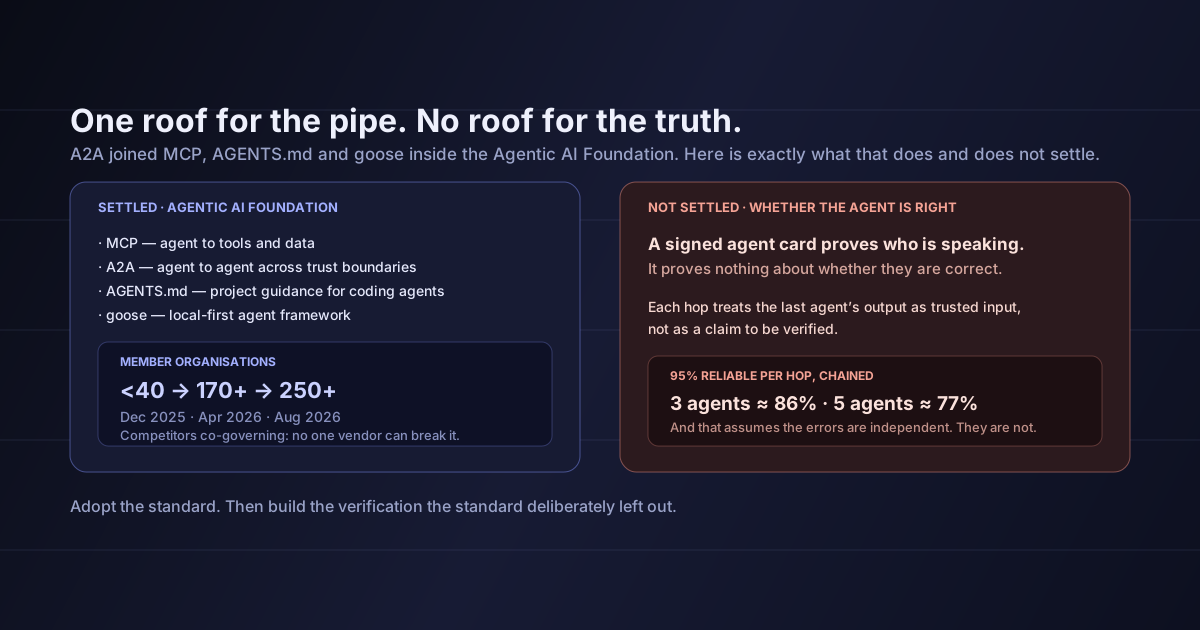
But a choice is exactly the kind of thing that can be re-made. There was no charter, no foundation, no governance structure making the neutral position durable against a change of mind or a change of owner. Compare that with the agent protocols, which moved under a neutral foundation precisely so that no single vendor could unilaterally change their direction.
The practical lesson is not "do not trust Hugging Face." It is that when you depend on a platform's neutrality, you should know whether that neutrality is structural or discretionary. Structural neutrality survives an acquisition. Discretionary neutrality is a preference held by whoever currently owns the company — and ownership is exactly the thing being reported.
Less than the drama suggests, and I said the same thing on Friday.
And the work is the same work, which is a good sign it was the right work: know what you pull, pin it, and mirror what you cannot rebuild. That is ordinary supply-chain hygiene which happens to also be the answer to this particular news cycle.
Strip the names out and this is a question every founder eventually faces: what is your independence actually worth, and would you recognise the moment the answer changed?
Hugging Face gave a precise answer in late 2025 — more than $500 million — and a different one nine months later. Neither answer is wrong. Circumstances genuinely change, and refusing to update a decision because you already announced a principle is its own kind of failure.
What is worth taking is the observation that the second answer arrived without a public account of the first being revised. If independence is part of what you sell to your users, the moment you trade it is the moment you owe them an explanation. That bill has not been paid here yet, and it is still outstanding while both companies decline to comment.
The Financial Times reports NVIDIA offered $500 million at a $7 billion valuation at the end of 2025 and was refused, because Hugging Face did not want one dominant investor influencing its decisions. The Information reports NVIDIA has now agreed to buy the company outright for $12.9 billion. Neither company has confirmed anything, no signed agreement has been reported, and the deal could still fall apart.
If it does complete, the interesting fact will not be the price. It will be that the objection Hugging Face raised in 2025 was never answered — it was resolved by being bought, and the reasoning was never made public.
For your stack, the advice has not moved since Friday: mirror what you depend on, pin your versions, and treat platform neutrality as a preference someone is currently choosing rather than a property you are entitled to.
Sources: Financial Times reporting on the declined $500m offer, as summarised by heise online · The Information, "Nvidia Agrees to Buy Open Source AI Platform Hugging Face For $12.9 Billion" · TechCrunch, "Nvidia closes in on Hugging Face acquisition" · Bloomberg · The $500m/$7bn refusal and its stated reason, and the $12.9bn price, are press reports not confirmed by either company; the four explanations in section 3 are my speculation and labelled as such.
IdeaToMVP Academy
4-week live cohort for founders. Learn to ship AI agents, scope MVPs, and automate your business — taught by the same team that writes these guides.