Anthropic Walked at the 90th Minute of a $6B Deal. Only One Reported Reason Was the Technology

By Surya Pratap
September 9, 2026
11 min read
AI & Technology

September 9, 2026
11 min read
 The facts, and the guessesHover to explore
Most acquisition coverage tells you what a company sold for. This one is about a deal that did not close, which is rarer and, for founders, more useful.
Anthropic reportedly ended talks to acquire Decart for around $6 billion — what would have been its largest known acquisition — after going deep into due diligence. Israeli press described it as almost signed, walked away from in the 90th minute.
Neither company has said why. What we have instead is a list of things people close to it thought plausible, and that list is the interesting artefact.
The Decart deal, as reported
The confirmed shape, before any explanation
Worth noting the timing: this lands weeks before Anthropic's anticipated IPO, with reporting pointing at mid-October marketing. A large, complicated acquisition immediately before a roadshow is a different proposition from the same deal a year earlier, and that is true regardless of anything about Decart.
The number I keep looking at is not the six billion. It is the gap.
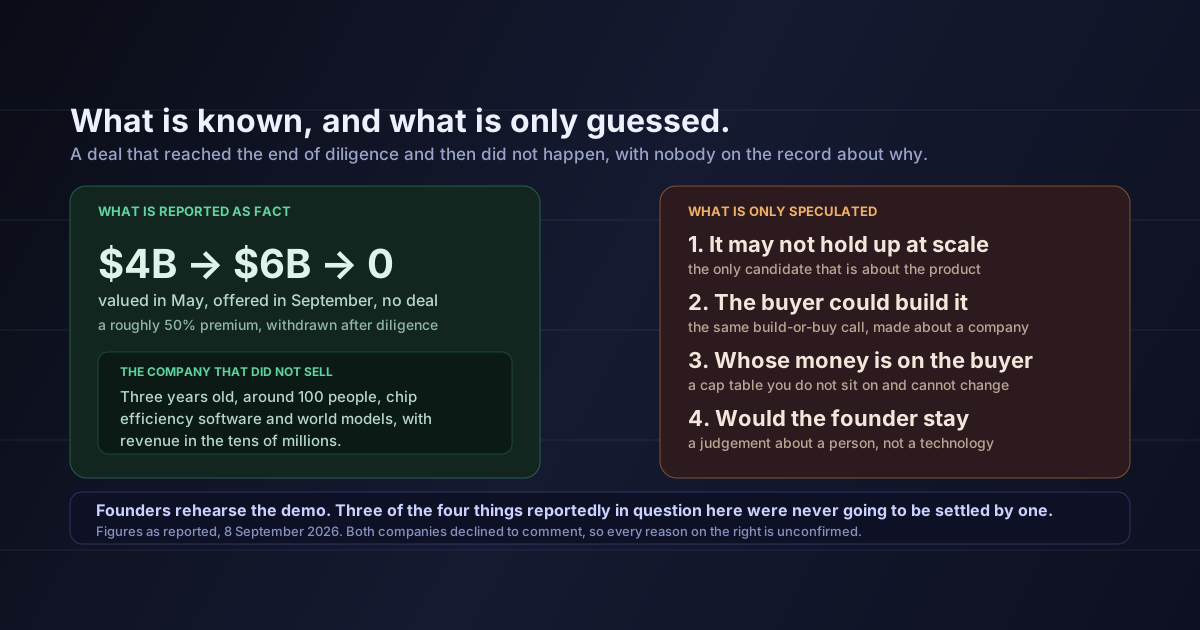
Worth $4B in May. Offered $6B in September. Sold for nothing.
Decart is, by every indication, fine — a well-funded company with real revenue, real investors and a live product line. Nothing about the walk-away necessarily says otherwise. But an offer at a 50% premium arrived and then evaporated after the buyer looked closely, and that is a specific kind of event that founders rarely get to observe from outside.
The uncomfortable part is that a signed term sheet is not a price. It is a price conditional on what diligence finds, and diligence looks at considerably more than the thing you spent three years building.
Reporting floats several possibilities. I want to be exact here: these are unconfirmed, both companies declined to comment, and I have no independent knowledge of which if any is true.
Read the list, not the verdict
Even as pure speculation the set is informative, because it is what people who watch these deals considered plausible enough to print. Sort them by whether a founder could have done anything about them and the picture gets bleak fast: the technology performing at scale is the only one that sits squarely inside the company's control, and even the founder-commitment question is a judgement someone else makes about you.
One: the technology may not hold up. That it underperformed at scale, or on non-Nvidia chips. This is the only candidate that is genuinely about the product, and it is the one every founder prepares for.
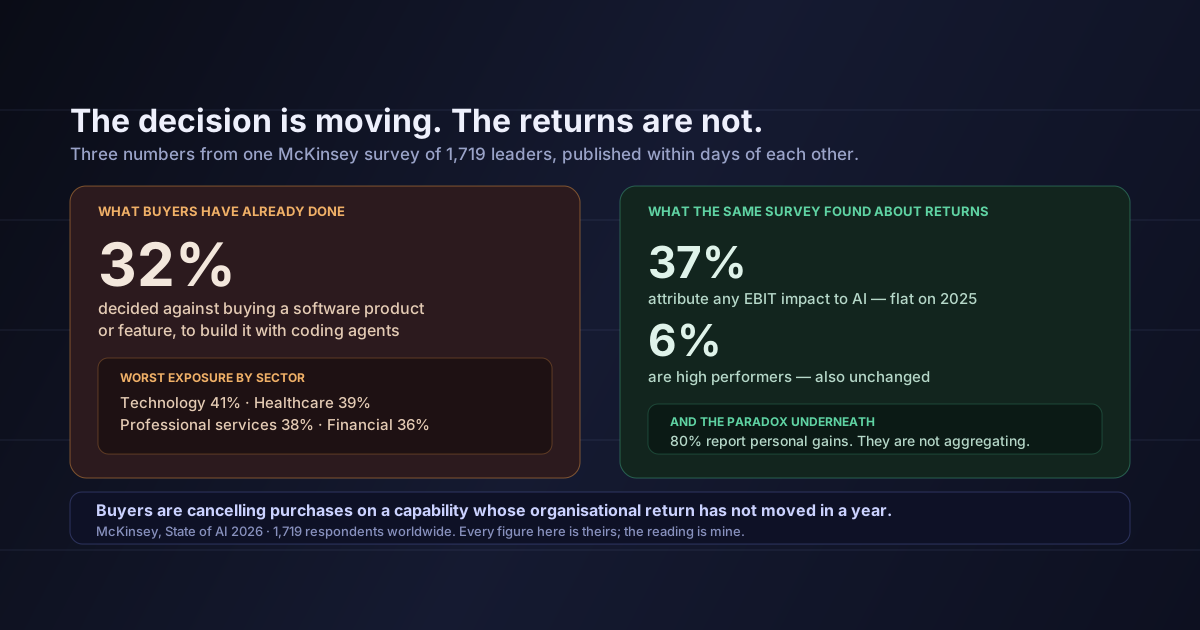
Two: the buyer decided it could build it. The same calculation I wrote about when 32% of organisations cancelled a software purchase to build it themselves — except applied to a whole company rather than a subscription. A frontier lab with enormous infrastructure talent asking "or we could just do this" is build-versus-buy at its most expensive.
Three: geopolitics on the buyer's cap table. Questions reportedly touching Qatar's investment in Anthropic and the acquisition of an Israeli company. Whatever the merit, note the structure: a risk located entirely on the other side of the table, invisible in your data room, unfixable by you.
Four: whether the founder would stay. A reported concern that the founder was more interested in the transaction than in a long run inside the acquirer. Retention is a standard diligence question and it is answered by impression, not by documentation.
That last point is doing quiet work. Decart raised $450 million and has tens of millions in revenue. A deal collapsing at this stage is a bad week, not an existential event. The same event at a company that had already spent its runway assuming the close would be a different story entirely.
This is not evidence that anything is wrong with Decart. Deals die for reasons that have nothing to do with the target's quality, and every explanation in circulation is unconfirmed. The company raised at a near-$4 billion valuation four months ago with Nvidia and Sequoia among its backers, and none of that has been retracted.
"Only one reason was the technology" is a claim about the reporting, not about reality. The actual reason might be the product, or something never mentioned publicly, or several things at once. What I can defend is that the plausible-looking list is mostly not about the product — which tells you what observers expect diligence to turn on.
Nobody involved is talking, and that is normal. Two companies declining to comment on a collapsed transaction is standard practice, not a signal. Treat all of this as one well-sourced report about a private process, and hold it loosely.
A three-year-old company was worth roughly $4 billion in May, was reportedly offered around $6 billion in September, and is now worth whatever it was worth before — which, to be clear, is a lot.
The founder-relevant part is what the near-miss exposes. Diligence is not a product review. It is a review of your product, your team's next four years, the buyer's alternative to buying you, and a pile of circumstances on their side that you will never see and cannot influence. Of the four explanations being floated for this one, exactly one lives inside the company being bought.
The practical response is not to prepare harder for the technical review, though you should. It is to build a company that does not need the transaction to close — because the reason it might not close is quite likely to be something you were never in a position to fix.
Sources: Bloomberg, "Anthropic Said to Walk Away From $6 Billion Decart Acquisition" · Calcalist, "What made Anthropic walk away from the $6 billion Decart deal?" · The Deep Dive on the terminated talks and Decart's funding history · PYMNTS on the scuttled acquisition · Deal figures, funding history and company details are as reported; every explanation for the walk-away is unconfirmed speculation, and the argument about what diligence tests is mine. For context on the other large AI infrastructure deal in play, see NVIDIA's Hugging Face acquisition.
IdeaToMVP Academy
4-week live cohort for founders. Learn to ship AI agents, scope MVPs, and automate your business — taught by the same team that writes these guides.