March 22, 2026
In November 2025, Peter Steinberger — who had already built and sold a PDF SDK company for over €100 million — spent a Saturday afternoon connecting WhatsApp to Anthropic's Claude API. The experiment took roughly one hour. He shared it publicly, almost as an afterthought. By January 30, 2026, it had accumulated 34,000 GitHub stars in 48 hours. By March, it had surpassed 250,000 — more than React, Kubernetes, and Linux had accumulated in their first years — making it arguably the fastest-growing repository in GitHub's history. The product was called OpenClaw. And almost nothing about its rise followed the standard playbook.
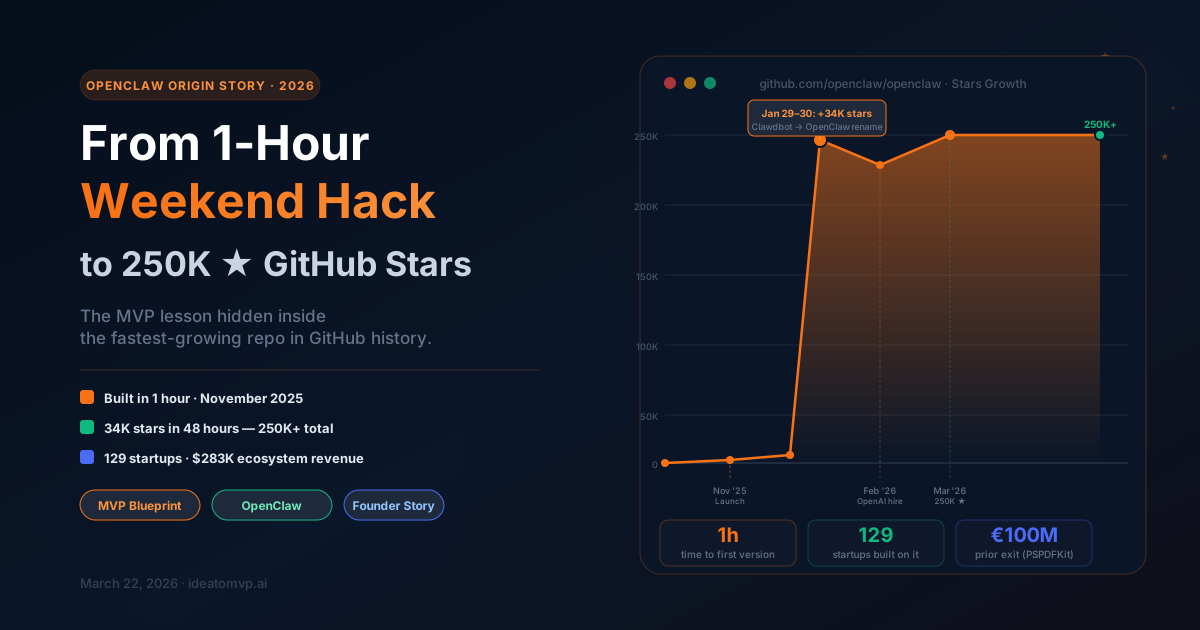
1h
time to build v1
34K
stars in 48 hours
250K+
total GitHub stars
129
startups built on it
Before OpenClaw, Steinberger was best known for PSPDFKit — a PDF SDK he built solo in 2011 that quietly became the rendering engine behind document handling for Apple, Adobe, Dropbox, and Disney. By the time he sold it to Insight Partners in a deal reported at over €100 million, nearly one billion people had used software powered by his code without knowing his name.
Post-exit, he experienced what he later described publicly as a severe creative block: “I couldn't get code out anymore. I was just staring and feeling empty.” He booked a one-way ticket to Madrid. He spent months doing almost nothing technical. Then, in a rented apartment on a quiet November weekend, he built a WhatsApp bot that could talk to Claude. He tweeted about it casually. Within hours it had thousands of reactions. Within weeks it was being called the most important open-source project of 2026.
The reason this story matters to every founder is not the outcome — it's the process. The way OpenClaw was built, named, shipped, and scaled contains a complete tutorial on what actually makes MVPs succeed, disguised as one person's very weird year.
“I built the first version in about an hour. I connected WhatsApp to Claude. It felt like magic. I just wanted to share it.”
— Peter Steinberger, Lex Fridman Podcast #491
The OpenClaw timeline is a case study in how quickly momentum can compound when a product solves a real problem:
Reading through the original Twitter and Reddit reaction to OpenClaw, a consistent pattern emerges. The most viral posts were not technical. They were experiential. Users were posting screen recordings of OpenClaw doing things that previously required an employee: summarising 200 emails, booking calendar slots, running a web scrape and returning structured data — all via a WhatsApp message.
On r/selfhosted and r/homelab, the initial discussion was almost exclusively about the self-hosted angle: no subscription, no data leaving your control, runs on your own infrastructure. This was a community that had been burned by SaaS products that disappeared or raised prices overnight, and OpenClaw was speaking directly to that anxiety.
On tech Twitter, the dominant comparison was to JARVIS from Iron Man — an AI that lives in your environment and does things, rather than answering questions. That comparison spread because it described in two words what would have taken two paragraphs to explain technically. The product had a cultural hook that a thousand startups spend millions trying to manufacture artificially.
On Hacker News, the Ask HN thread “Any real OpenClaw users? What's your experience?” surfaced the most granular picture: power users reporting 30–45 minutes saved per day on email triage alone. Research workflows compressed from hours to minutes. And honest criticism about the setup overhead and the risk of runaway automation — which itself was useful signal for anyone building in this space.
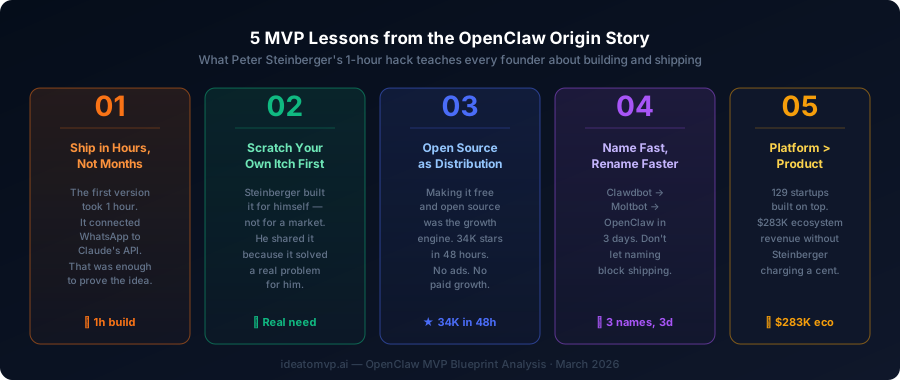
Steinberger is an experienced, wealthy engineer with no financial pressure whatsoever. He could have spent three months building a polished product. He spent one hour. Not because he was lazy — because he was curious. He wanted to know if connecting these two things would feel like magic. It did. And that was the signal he needed to know it was worth pursuing further.
Most founders spend three to six months building a polished version of a product before they know whether the core experience feels like magic to users. The question Steinberger answered in one hour — “does this feel like magic?” — is the only question worth answering first. Everything else is premature.
There was no market research before OpenClaw. No user interviews. No competitor analysis. No TAM calculation. Steinberger was not trying to find a market — he was trying to solve a frustration he had personally. He wanted a smarter assistant that lived inside the messaging app he already used. He built it for himself and shared it because it seemed worth sharing.
This is not an argument against market research. It is an argument against using market research as a substitute for genuine personal conviction. The products that spread fastest are almost always built by someone who was the first target user — who knows exactly how frustrating the problem is because they live it daily. You cannot fake that depth of understanding with a survey.
“The most viral products are built by people who couldn't wait for someone else to solve their problem. Steinberger wasn't trying to disrupt AI assistants. He just wanted a better inbox.”
Making OpenClaw free and open-source was not a commercial strategy. But it produced a commercial outcome. Zero acquisition cost. Zero friction to try it. Every developer who starred the repo became a distribution node. Every tutorial someone wrote for their own blog became organic SEO. Every startup that built on top of the platform created a constituency that had skin in the game for its continued success. 34,000 stars in 48 hours does not happen with a paywalled SaaS trial. It happens when there is nothing standing between the person and the “try it” moment.
In three days, the product had three names: Clawdbot, Moltbot, OpenClaw. Most founders treat naming as a gate-keeping exercise — a prerequisite before anything else can happen. They spend weeks agonising over domain availability, trademark searches, and brand consistency before a single user has touched the product. Steinberger shipped first, dealt with the trademark issue when it arrived, and renamed twice in 72 hours without visible damage to momentum. The market does not care what your product is called on day one. It cares whether it solves the problem.
By March 2026, 129 independent startups had built revenue- generating businesses on top of OpenClaw — totalling $283,000 in combined ecosystem revenue, none of which required Steinberger to do anything. The ClawHub marketplace had 700+ skills, with indie developers reporting $100–$1,000 per month from individual skill listings. This is the compounding return of platform thinking: instead of building every use case yourself, you create the infrastructure that lets your users build the use cases for you. The product becomes the ecosystem. The ecosystem becomes the moat.
OpenClaw's security crisis — CVE-2026-25253, the 335 malicious ClawHub skills, the one-click RCE vulnerability, Meta banning it on work devices — is not just a security story. It is a product story. Specifically, it is the story of what happens when distribution velocity outpaces trust infrastructure.
OpenClaw was designed to be maximally capable and minimally restricted — it could read your email, run terminal commands, post to social media, and ingest untrusted content from the web, all in a single agent session. Security researchers describe this as the “lethal trifecta” for AI agent products: access to private data + ability to communicate externally + ability to ingest untrusted content. OpenClaw ticked all three by design.
The lesson for founders building agentic AI products is not “move slowly.” It is “build trust infrastructure in parallel with capability.” Permission scoping, sandboxed execution environments, audit logs, and user consent flows are not features you add after security incidents. They are the table stakes for any product that asks users to give an AI agent access to something they care about. OpenClaw's security crisis was both entirely predictable and entirely avoidable — and NVIDIA's announcement of NemoClaw, a hardened enterprise version, suggests the market will gladly pay a premium for the secure version of any breakthrough AI tool.
The OpenClaw story is not a template to replicate — Steinberger had deep technical ability, prior credibility, and the financial freedom to experiment without fear. But the principles it demonstrates are available to any founder:
“Talking to Peter was truly mind-blowing. What he built in an hour — and what it became — is one of those stories that makes you reconsider everything you thought you knew about how products should be built.”
— Lex Fridman, Podcast #491
There is a version of the startup advice industrial complex that would tell you OpenClaw's success was a lucky accident — a technically accomplished founder, a perfect moment in AI adoption, and an open-source audience primed to receive it. That framing is comfortable because it makes the lesson non-transferable. If it was luck, you don't have to change anything about how you work.
But the honest read is different. Steinberger built in one hour because he prioritised the answer to a single question over the completeness of the product. He shared publicly because he assumed other people shared his frustration. He open-sourced it because he cared more about distribution than monetisation at the early stage. He renamed three times in 72 hours because he refused to let a naming dispute slow him down. These are choices. They are available to you right now. The question OpenClaw actually asks you is: what are you waiting for to find out?
At Idea to MVP, we help founders validate ideas fast and ship real MVPs in 4–8 weeks. No months of planning. No agency overhead. Just the minimum version that answers the right question.
Book a Free Discovery Call