Agent Orchestration with LangGraph: Patterns, Production Gotchas & What Reddit & X Say (2026)

By Surya Pratap
June 16, 2026
12 min read
AI & Technology

June 16, 2026
12 min read
In early 2026, the loudest thread on r/LangChain is no longer “which framework should I use?” It is “how do I orchestrate agents without the graph becoming unmaintainable?” The same shift shows up on X, where builders who shipped with CrewAI for speed are now posting migration stories once they need branching, approvals, or crash-safe resume. LangGraph has become the default answer for that second problem—not because it is easy, but because it is the only mainstream framework that treats orchestration as a first-class state machine instead of a chat transcript.
This piece synthesizes patterns from the official LangGraph docs, recurring discussion on r/LangChain and r/LocalLLaMA, and threads from @LangChainAI, @hwchase17, and production write-ups from teams benchmarking LangGraph against CrewAI and AutoGen. Patterns > cherry-picked quotes.
 Graph-first orchestrationHover to explore
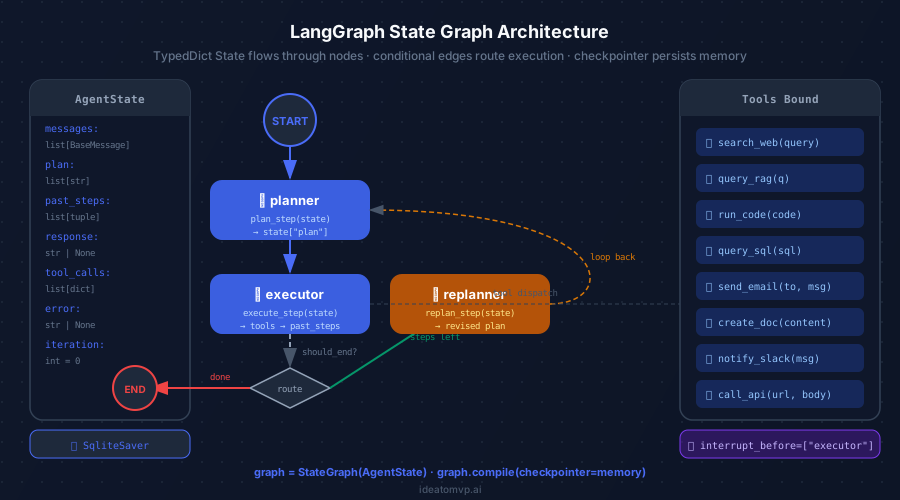
Harrison Chase has been consistent on this since the LangGraph launch: chains are DAGs; agents need cycles. Orchestration is what happens when one loop is not enough—you need a router that picks specialists, workers that run in parallel, an evaluator that sends output back for revision, or a human who can pause the run before money moves.
The Reddit consensus in 2026 is blunt: most teams reach for multi-agent orchestration too early. A single create_agent with 3–5 well-scoped tools beats a three-node graph that re-implements the same loop with extra latency. LangGraph earns its keep when at least one of these is true:
LangGraph is intentionally low-level. That is the point. Every orchestration pattern composes the same building blocks:
Annotated[list, add] so parallel nodes merge instead of overwrite.MemorySaver for dev; PostgresSaver or RedisSaver for production.from typing import Annotated, TypedDict
from langgraph.graph import StateGraph, START, END
from langgraph.checkpoint.memory import MemorySaver
import operator
class OrchestrationState(TypedDict):
messages: Annotated[list, operator.add]
next_agent: str
def router(state: OrchestrationState) -> OrchestrationState:
# classify intent, set next_agent
return {"next_agent": "researcher"}
def researcher(state: OrchestrationState) -> OrchestrationState:
return {"messages": ["Found 3 relevant sources."]}
def route_next(state: OrchestrationState) -> str:
return state["next_agent"] if state["next_agent"] != "done" else END
builder = StateGraph(OrchestrationState)
builder.add_node("router", router)
builder.add_node("researcher", researcher)
builder.add_edge(START, "router")
builder.add_conditional_edges("router", route_next)
builder.add_edge("researcher", "router")
graph = builder.compile(checkpointer=MemorySaver())
graph.invoke(
{"messages": ["Summarize our Q2 churn."], "next_agent": ""},
config={"configurable": {"thread_id": "user-42"}},
)
The verbosity is real—benchmarks and Reddit threads routinely cite ~60 lines for LangGraph vs ~20 for an equivalent CrewAI crew. What you buy with those extra lines is inspectable state at every transition, which is why production teams on X describe LangGraph as “harder to start, easier to debug.”
One node classifies intent and routes to specialist agents (support, billing, research). This is the pattern behind langgraph-supervisor and the most common enterprise deployment shape. Reddit praise: clear role boundaries. Reddit complaint: the supervisor prompt becomes a god-object if you cram twelve intents into one router.
A planner node decomposes a task into subtasks; worker nodes execute in parallel via LangGraph's Send API; a synthesizer merges results. Ideal for “analyze these 50 documents” or “draft sections of a report.” X builders call this the pattern that finally makes multi-agent worth the overhead—because subtasks are genuinely unknown upfront.
Generator produces output; evaluator scores it against criteria; conditional edge loops back or exits. Common for code generation, compliance drafts, and marketing copy. The loop is native to LangGraph—no hacky “try again” prompts required.
Use interrupt() inside a node or interrupt_before=['execute_payment'] at compile time. State checkpoints to Postgres; the graph waits indefinitely; resume with Command(resume=...) and the same thread_id. This is the feature LangChain highlights most on X—and the one r/LangChain threads say separates toy demos from finance/ops deployments.
from langgraph.types import interrupt, Command

def approval_node(state):
    decision = interrupt({"action": "refund", "amount": state["amount"]})
    if decision["approved"]:
        return {"status": "refunded"}
    return {"status": "rejected"}

# Resume hours later:
graph.invoke(
    Command(resume={"approved": True}),
    config={"configurable": {"thread_id": "order-9912"}},
)
A compiled graph becomes a single node in a parent graph. Teams on Reddit describe a hybrid that keeps appearing: CrewAI or a simple chain for the outer workflow, LangGraph subgraphs for agents that need loops, tools, or HITL. LangGraph 1.0 (announced on X in late 2025) formalized this as the recommended scale-up path—start with LangChain's create_agent, drop to LangGraph when you need determinism.
 Checkpoint + traceHover to explore
The community has moved past framework religion into operational specifics. These show up repeatedly across r/LangChain, r/LocalLLaMA, and production postmortems linked on X:
interrupt_after executes the action first—then asks for approval. That is backwards for anything irreversible.PostgresSaver from day one if money, messages, or compliance are involved.“CrewAI gets you to demo in an afternoon. LangGraph gets you to a run you can resume after a deploy on Thursday.” — recurring sentiment across framework comparison threads, echoed on X by teams that prototype in CrewAI and harden in LangGraph.
After reviewing months of r/LangChain and r/LocalLLaMA threads, plus the LangChain 1.0 announcement discourse on X from Harrison Chase and @LangChainAI, the themes cluster cleanly:
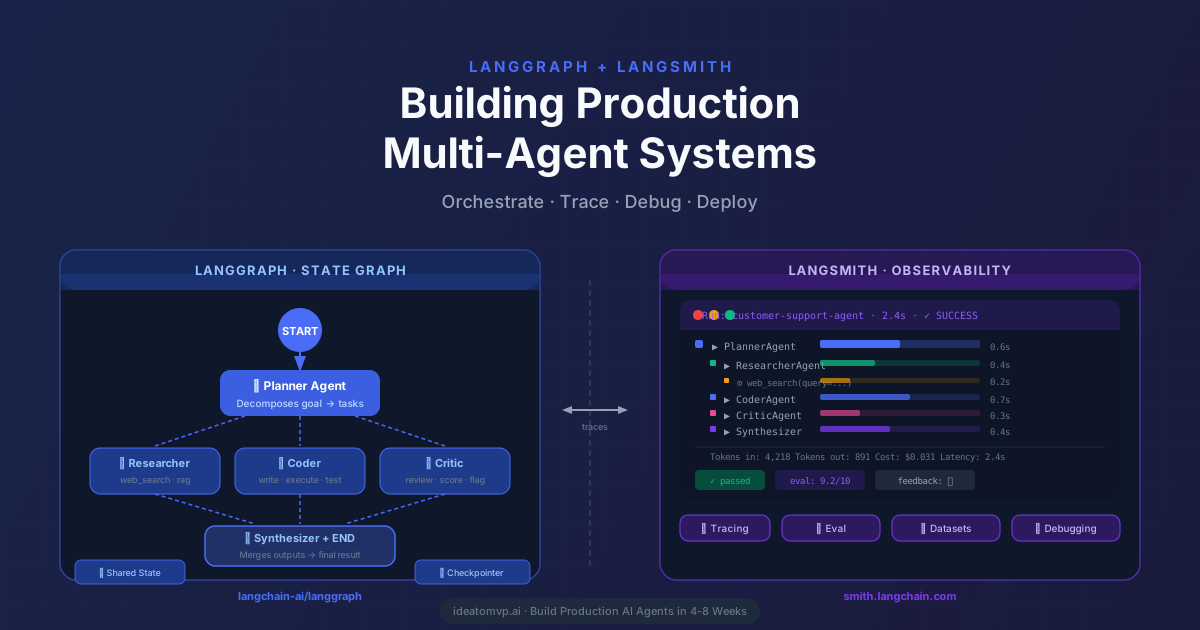
interrupt() are described as “the reason we picked LangGraph over rolling our own.” LangSmith trace integration is called “boring in the best way.” LangGraph 1.0 is seen as a stability signal, not a marketing stunt.Founders we work with get the best ROI from LangGraph when the MVP's core value is coordination, not raw model intelligence:
If your MVP is “chat with my PDF,” skip orchestration. If it is “process this invoice, match it to a PO, and queue an approval,” LangGraph is the right default in 2026.
PostgresSaver and a real thread_id strategy from commit one.interrupt_before on any node that spends money, sends external communication, or mutates production data.recursion_limit and max evaluator iterations explicitly.Agent orchestration is not about collecting more agents—it is about making control flow explicit, state durable, and failures recoverable. LangGraph is the framework the community has converged on for that job, even while Reddit and X continue to debate whether you need it on day one. The winning teams in 2026 start simple, add graph nodes only when branching or durability demands it, and treat thread_id plus checkpointing as non-negotiable infrastructure—not polish you add after launch.
IdeaToMVP Academy
4-week live cohort for founders. Learn to ship AI agents, scope MVPs, and automate your business — taught by the same team that writes these guides.