Essential Features to Include in Your First MVP

By Surya Pratap
January 20, 2025
MVP Strategy

January 20, 2025
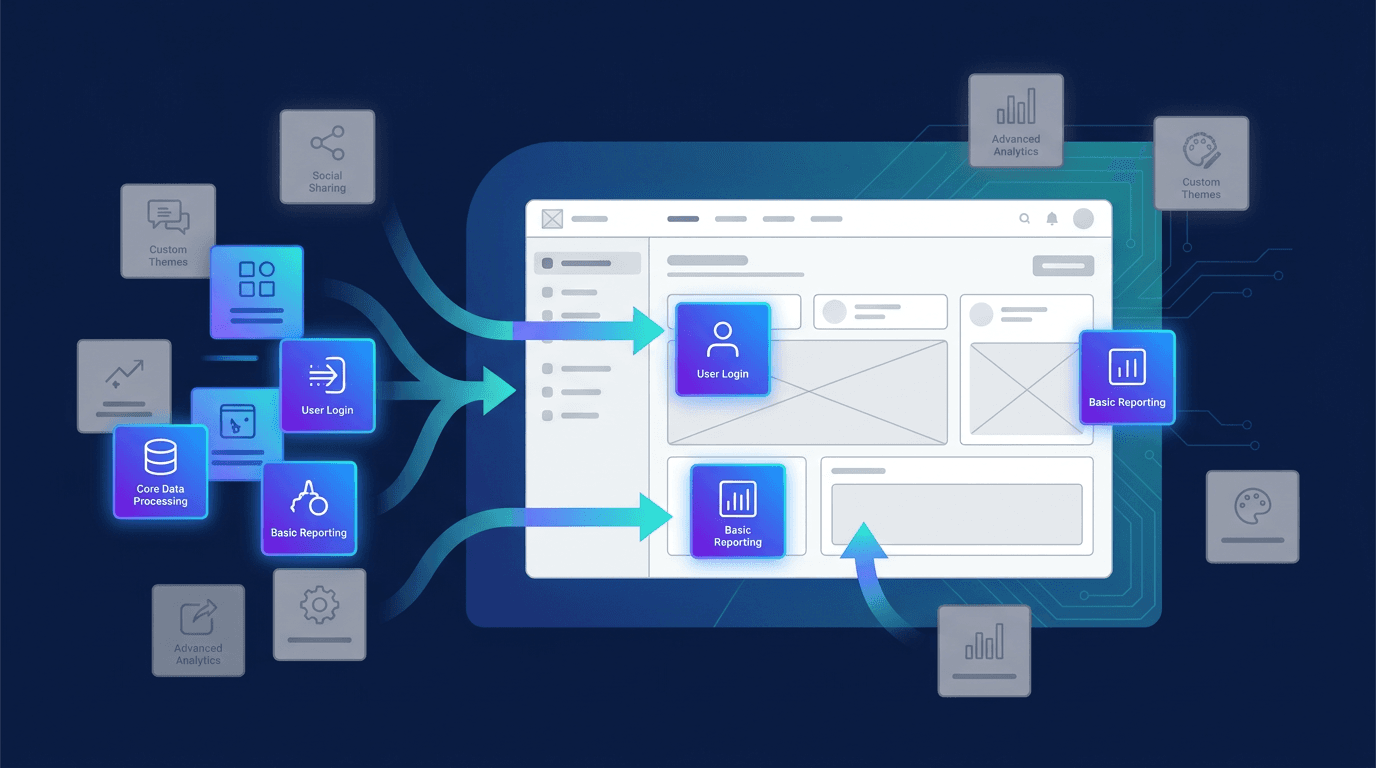
Every founder faces the same agonizing question when building their first product: “What do I actually need to build?” The temptation is to include everything — every feature you can imagine, every edge case you can think of, every competitor feature you've seen. But that's not an MVP. That's a recipe for a product that never ships.
A true MVP is the smallest version of your product that delivers enough value to attract early adopters and generate real learning. Getting this right is the difference between launching in weeks versus building for months and still missing the mark.
Before listing features, answer one question: What is the single most important problem you're solving, and for whom? Your MVP's feature set should flow directly from this answer. If a feature doesn't help test whether your core hypothesis is right, it doesn't belong in v1.
Think of it this way: Uber's MVP wasn't an app with driver ratings, fare splitting, multiple car types, and scheduled rides. It was “tap a button, get a car.” That single capability validated the core hypothesis — people will pay for on-demand rides through their phone. Everything else came later.
Regardless of your product type, these foundational elements are non-negotiable:
Users need to create accounts, log in, and get started quickly. Keep it simple — email/password or social login (Google, GitHub, etc.). Skip complex role hierarchies for v1. The onboarding flow should get users to their first “aha moment” in under 60 seconds. If your onboarding takes 10 steps, you'll lose 80% of signups before they see any value.
This is the heart of your MVP — the one capability that directly solves the problem you identified. It should be functional, usable, and deliver real value. One feature done excellently beats ten features done poorly. For a project management tool, this might be task creation and assignment. For a marketplace, it's listing and discovery. For an analytics tool, it's one key dashboard.
If your business model involves charging users, include payment from day one. Use Stripe or Razorpay — don't build custom billing. A simple pricing page with one or two plans is enough. Charging early isn't just about revenue; it's the strongest form of validation. Users who pay are fundamentally different from users who sign up for free.
Your MVP exists to learn. Build in a way for users to tell you what they think — a feedback widget, a simple contact form, or even a direct link to a Typeform survey. Track what users ask for most. Their feature requests will shape your v2 roadmap better than any brainstorming session.
You need to know what's happening inside your product. At minimum, track signups, daily active users, core feature usage, and drop-off points. Tools like Mixpanel, PostHog, or even Google Analytics give you this with minimal setup. If you can't measure it, you can't learn from it.
“The goal of an MVP is not to build a product with fewer features — it's to build the smallest product that delivers maximum learning about your users and validates your business hypothesis.”
These features are valuable but shouldn't block your launch:
These are the features founders waste the most time on before they should:
For every feature on your list, score it across two dimensions: how critical it is to testing your core hypothesis, and how much effort it takes to build. This gives you four quadrants:
| Low Effort | High Effort | |
|---|---|---|
| High Impact | Build first (MVP core) | Build if time allows |
| Low Impact | Nice-to-have (v2) | Skip entirely |
Be ruthless. Most founders overestimate how many features belong in the “high impact” row. If you have more than 3-5 core features in your MVP, you're probably building too much.
User authentication (signup, login, password reset)
Core feature that solves the #1 problem
Simple onboarding flow (< 60 seconds to value)
Payment integration (if charging from day one)
Feedback collection mechanism
Basic analytics (signups, DAU, feature usage)
Responsive design (works on mobile browsers)
Error handling and basic loading states
Security essentials (HTTPS, input validation, auth tokens)
Deployment pipeline (ship updates quickly)
Your first MVP should be embarrassingly simple. If you're not a little uncomfortable with how few features it has, you've probably built too much. The goal isn't to impress users with a feature list — it's to learn whether the core problem you're solving actually matters to them.
Build the minimum. Ship fast. Learn from real users. Then build the next thing they actually need — not what you assumed they would.
IdeaToMVP Academy
4-week live cohort for founders. Learn to ship AI agents, scope MVPs, and automate your business — taught by the same team that writes these guides.