March 6, 2026
It's 2026. AI can write code, build UI components, deploy apps, and even architect multi-agent systems. Tools like Cursor, Replit Agent, Lovable, and Bolt have made it possible for anyone with an idea to generate a working prototype in hours.
So why are 8,000+ “vibe-coded” startups requiring complete rebuilds? Why are founders burning through $50K-$500K in rescue engineering? And why is the gap between “AI-generated demo” and “production-ready product” wider than ever?
Let's break this down — honestly — for founders trying to figure out how AI actually fits into building a startup MVP in 2026.
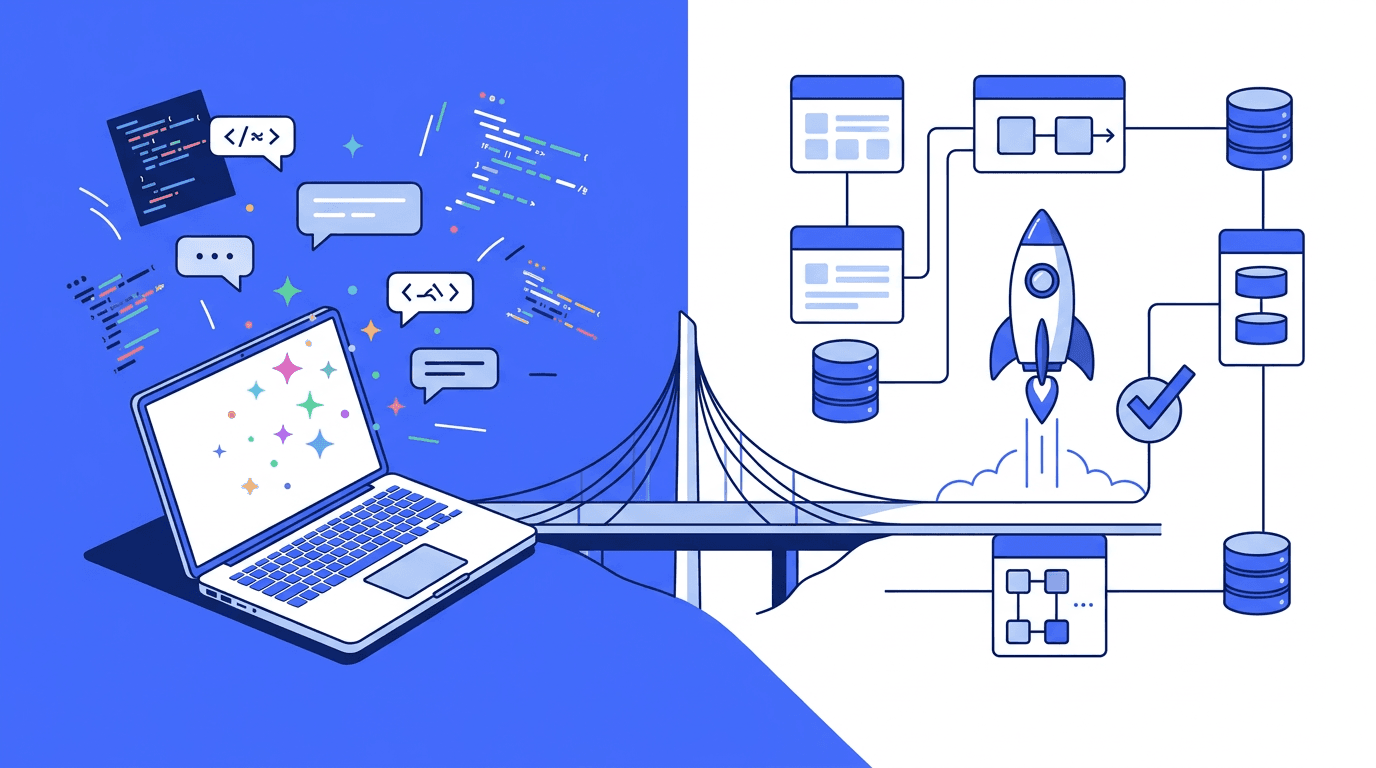
The term was coined by Andrej Karpathy (former Tesla AI Director, OpenAI founding member) in early 2025. The idea: describe what you want in plain English, let AI generate the code, and just “go with the vibes.” Don't read the code. Don't review the architecture. Just keep prompting until it works.
And for prototyping? It genuinely works. Founders with zero technical background are generating working demos in a weekend. The barrier to entry for building software has never been lower. That part is real and worth celebrating.
But here's where it breaks down.
“I have been trying to launch something for past couple of months. After a few iterations the code gets stuck, or when it becomes complex the vibe coding tools cannot produce better results. Half the time AI feels better than humans, half the time humans feel better.”
— u/Additional_Cod_6445, r/vibecoding
AI coding tools are excellent at the first 80% of a project — scaffolding, boilerplate, UI components, CRUD operations, basic logic. This is the part that feels magical.
The remaining 20% is where things get real: edge cases, security, error handling, performance, integrations, and the hundred small decisions that separate a demo from a product people pay for.

Here's what that 20% actually looks like:
“Code is cheap in 2026, but wrong architecture is still expensive. Vibe coding tools cannot handle complex structural decisions. Projects turn into spaghetti after a few days because the foundational architecture lacks cohesion.”
— r/vibecoding (top post, 2026)
8,000+
Vibe-coded startups needing rebuilds
$4B
Estimated cleanup costs industry-wide
45%
Higher vulnerability rate in AI code
AI agents are the most exciting — and most overhyped — category in startup development right now. Every founder wants to build one. LangChain has made it accessible. GPT-4 and Claude make the demos impressive.
But building AI agents that work in production is a fundamentally different problem than building a demo that works in a screen recording.
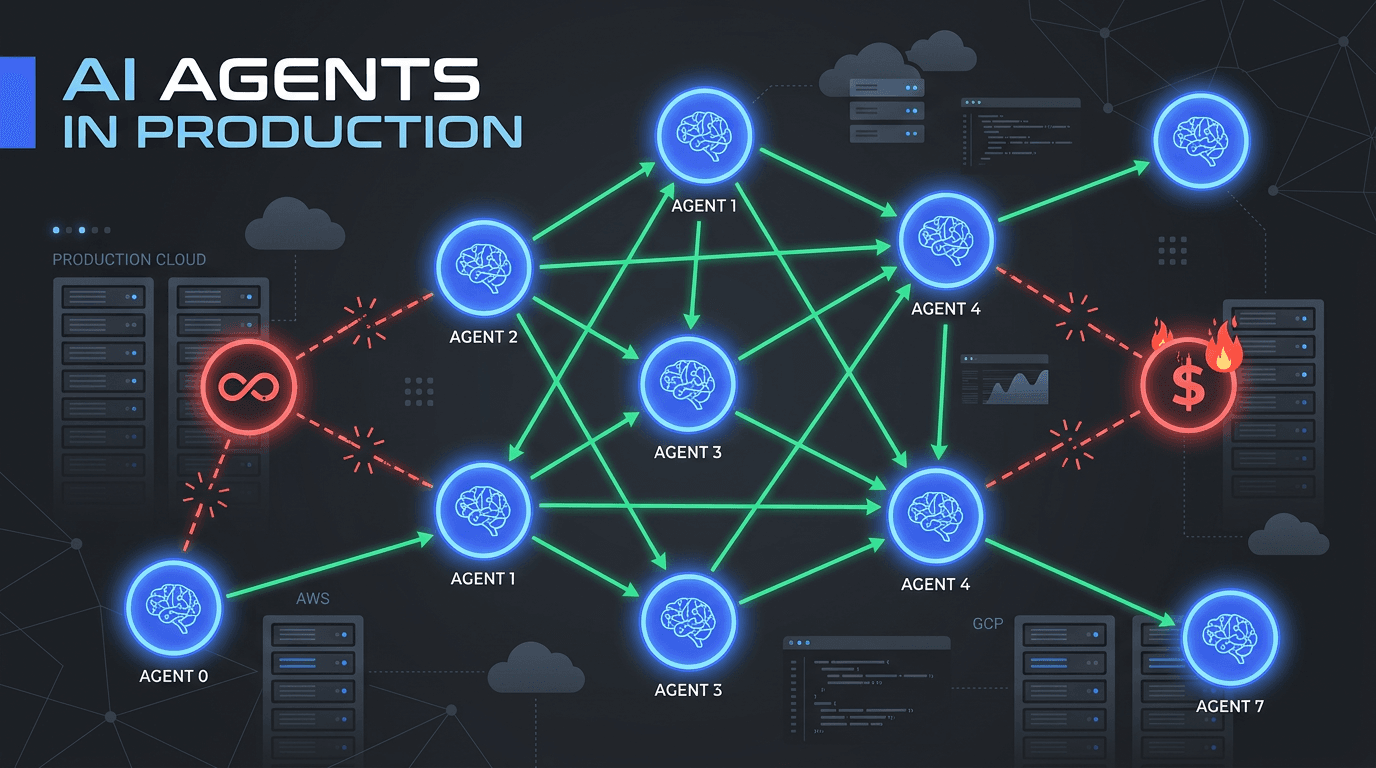
One development firm reported that 9 of their first 14 AI agent projects failed spectacularly:
The takeaway: AI agent frameworks (LangChain, CrewAI, AutoGen) make it easy to build a demo. Making that agent reliable, cost-efficient, and safe for real users requires serious engineering — error handling, fallback logic, cost guards, human-in-the-loop escalation, and extensive testing.
The most cited cautionary tale in the vibe coding community is Enrichlead — a startup that publicly bragged about being “100% Cursor, zero hand-written code.” They launched, got attention, and then shut down almost immediately because of security flaws so basic that any user could modify other users' data or access paid features for free.
The code worked. The product didn't. That's the gap.
“Vibe coding taught me that you can't outsource understanding forever. Vibes get you to MVP, but scaling requires knowing what you don't know.”
— r/vibecoding
This isn't an anti-AI argument. AI tools are incredibly useful. The problem is treating them as a complete solution rather than what they are: acceleration tools for the prototyping phase.
Here's the framework that actually works for founders:
AI coding tools are great for building quick prototypes to test your idea. Use Cursor, Bolt, or Replit to build a clickable demo. Show it to potential users. Get feedback. This phase should take days, not months. Vibe coding is perfect here.
Once you've validated the idea, don't try to vibe code your way to production. This is where you need someone who understands system architecture, security, scalability, and the hundred decisions that AI tools consistently get wrong. A prototype is not a product.
The best outcomes we see are when experienced engineers use AI tools to move faster — not when AI replaces engineering. Our team uses Cursor, Copilot, and Claude daily. They make us 2-3x faster. But the architectural decisions, security reviews, and production hardening still require human judgment.
Authentication. Error handling. Rate limiting. Input validation. Monitoring. Backups. Testing. CI/CD. None of this is exciting. All of it is required for a product that real people trust with their data and money. AI tools routinely skip or botch these.
| Vibe Coding | AI + Engineering | |
|---|---|---|
| Speed to Demo | Hours | Days |
| Speed to Production | Never (requires rebuild) | 4-8 weeks |
| Security | 45% more vulnerabilities | Audit-ready |
| Scalability | Breaks at ~100 users | Built to scale |
| Fundraising Ready | Demo only | Investor-grade |
| Total Cost | $300 + $50K-500K rebuild | $8K-$18K (done right the first time) |
AI is transforming how software gets built. That's not debatable. But “anyone can build an app now” is misleading. Anyone can build a demo. Shipping a product that acquires users, handles their data safely, survives real-world usage, and impresses investors — that still requires engineering.
The smartest founders in 2026 are using AI for speed and engineers for substance. They vibe code to validate. They hire to ship.
“There's a big difference between vibe coding and software engineering. One gets you a demo. The other gets you a company.”
We use AI tools to move fast and engineering to ship right. 15+ MVPs launched. $2.4M+ raised by our founders. 4-8 week delivery.
Book a Free Discovery Call