


Agentic Orchestration for MVP Development: The 2026 Founder's Playbook

Surya Pratap
By Surya Pratap

March 15, 2026

10 min read

AI Agents · MVP Strategy

A single AI agent can write code. A single AI agent can run a test. But a coordinated system of agents can take a product requirement, break it into tasks, assign each task to the right specialist, validate the outputs, and surface a pull request — while you sleep. That's agentic orchestration, and in 2026 it's the highest-leverage technique available to founders building their first MVP.
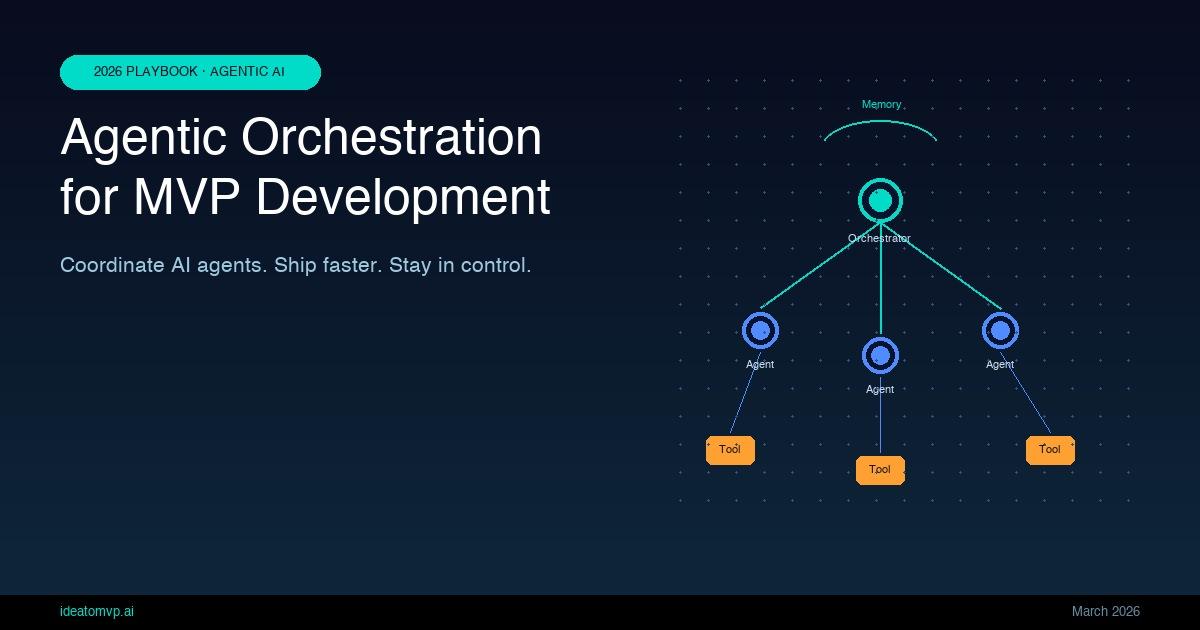
Agentic orchestration system coordinating multiple AI agents for MVP developmentLive agent networkHover to explore
Hover to explore the orchestration layer: a Planner agent breaks goals into tasks, delegates to specialist Worker agents, and synthesizes outputs — all coordinated through shared memory and tool access.

1. What agentic orchestration actually means for founders

Orchestration isn't a single LLM call. It's a control layer that decides which agent runs next, with what context, and how its output feeds into the next step. Think of it like a technical project manager — except it never sleeps, never loses context, and can run 20 tasks in parallel.

For MVP development, the orchestrator typically manages:

  • Task decomposition — breaking a user story into atomic agent tasks
  • Agent routing — sending each task to the right specialist (coder, tester, reviewer)
  • State & memory — keeping shared context so agents don't repeat work
  • Error recovery — detecting when a subtask fails and retrying or rerouting

Diagram — Orchestration Architecture

OrchestratorPlannerDev AgentQA AgentResearchCode / GitTest RunnerShared Memory / Context Store

The orchestrator delegates tasks to specialist agents. Each agent uses its own tools. All agents share a central memory store so context is never lost between steps.

2. The three orchestration patterns that matter for MVPs

Not every product needs the same wiring. Founders on X who have shipped with multi-agent systems in 2025–2026 have converged on three core patterns, each suited to a different class of problem:

Diagram — Three Orchestration Patterns

Sequential PipelinePlanBuildTestDeployParallel Fan-outPlannerAgent AAgent BAgent CSynthesizerHierarchicalCEOManagerDevQAManagerUXOps

Sequential — best for ordered workflows (spec → code → test → ship). Parallel — best when subtasks are independent (feature branches, research). Hierarchical — best for large builds with many specializations.

3. The four-agent MVP stack

You don't need dozens of agents to ship your first orchestrated MVP. The most battle-tested starting point in 2026 is a four-agent stack, each agent owning one phase of the build cycle:
  1. Spec Agent — takes your user story or PRD, breaks it into acceptance criteria, and outputs a structured task list with priorities. Never skips this step: ambiguous input is the #1 cause of agent loops.
  2. Dev Agent — reads the task list, writes code, commits to a branch, and annotates each file change with its reasoning. Keeps a memory of which files it has touched to avoid redundant rewrites.
  3. QA Agent — runs tests, checks type safety, scans for obvious security issues, and outputs a pass/fail verdict with a diff summary. Reports back to the orchestrator, not directly to the Dev Agent.
  4. Review Agent — synthesizes the QA report and code changes into a human-readable PR description, flags scope creep or regressions, and creates the pull request for your final review.
Four-agent MVP stack in actionAgent stackHover to explore
Hover to see the four agents in action: Spec → Dev → QA → Review, each handing off structured outputs so the next agent has everything it needs to start without any ambiguity.

4. Shared memory: the piece most founders miss

Agents running in isolation are just expensive autocomplete. The compounding value of orchestration comes from shared, structured memory — a store that every agent can read from and write to so the system builds up a coherent picture of the product over time.

Diagram — Memory Architecture

Memory Store(vector + key-value)Spec AgentDev AgentQA AgentReview Agentread / writeread / writeread / writeread / write

Every agent reads from and writes to the same memory store. The Spec Agent writes the task list; the Dev Agent reads it and writes code decisions; the QA Agent reads both and writes the test verdict.

A minimal memory store for an MVP needs three buckets:

  • Episodic — what happened in this session (task log, decisions, errors)
  • Semantic — facts about the product (schema, API contracts, user personas)
  • Procedural — agent rules and constraints (what each agent is allowed to do and not do)

5. The three failure modes founders hit (and how to avoid them)

Twitter/X is littered with threads from founders who ran up $800 API bills overnight because their agent loop never terminated. Agentic systems can fail in ways that feel invisible until they're very expensive. The three most common failure modes in 2025–2026 MVP builds:

  1. Agent drift — an agent gradually diverges from its original goal as context accumulates. Fix: hard token limits per task, plus an explicit “check alignment” step that compares current output to the original spec before continuing.
  2. Infinite retry loops — a failing subtask is retried indefinitely. Fix: set a max-attempts ceiling (3 is usually enough), and on failure escalate to a human checkpoint rather than looping silently.
  3. Cost blowout — parallel fan-out with expensive models burns budget fast. Fix: use cheaper models (GPT-4o mini, Haiku) for subtasks and reserve your best model for the final synthesis step only.
Monitoring dashboard for agentic orchestration systemObserve & controlHover to explore
Hover to explore the observability layer: trace each agent call, inspect memory snapshots, and set budget and retry guardrails before you ever run your pipeline at scale.

6. Choosing your orchestration stack in 2026

The framework landscape has consolidated. For an MVP in 2026, you're choosing between:

Diagram — Framework Comparison

FrameworkControlSpeedCostBest ForLangGraphHighMediumLowComplex flowsAutoGenMediumHighMediumMulti-agent chatCrewAIMediumHighLowRole-based teamsClaude SDKHighHighMediumCustom + control

For most MVPs: start with CrewAI or AutoGen for speed, migrate to LangGraph or the Claude Agent SDK when you need fine-grained control over state and branching.

“The orchestrator is your CTO. The agents are your engineers. Shared memory is your Notion. The difference between a toy agent demo and a shipped MVP is whether you've wired all three together — before you write a single feature.”

Agentic orchestration isn't about replacing your engineering judgment — it's about multiplying it. The founders who win in 2026 won't be the ones with the most agents; they'll be the ones with the tightest loops, the clearest memory schemas, and the discipline to keep humans in the loop at the decisions that actually matter.

Ready to build your agentic MVP?

We design and ship orchestrated AI MVPs for founders — from architecture to deployed product in 4–8 weeks.

Book a Free Discovery Call
Share this post :