Vertical AI Integration for Enterprises: Owning the GPU, Model, and Application Layers in 2026

Surya Pratap
By Surya Pratap

July 7, 2026

11 min read

AI & Technology

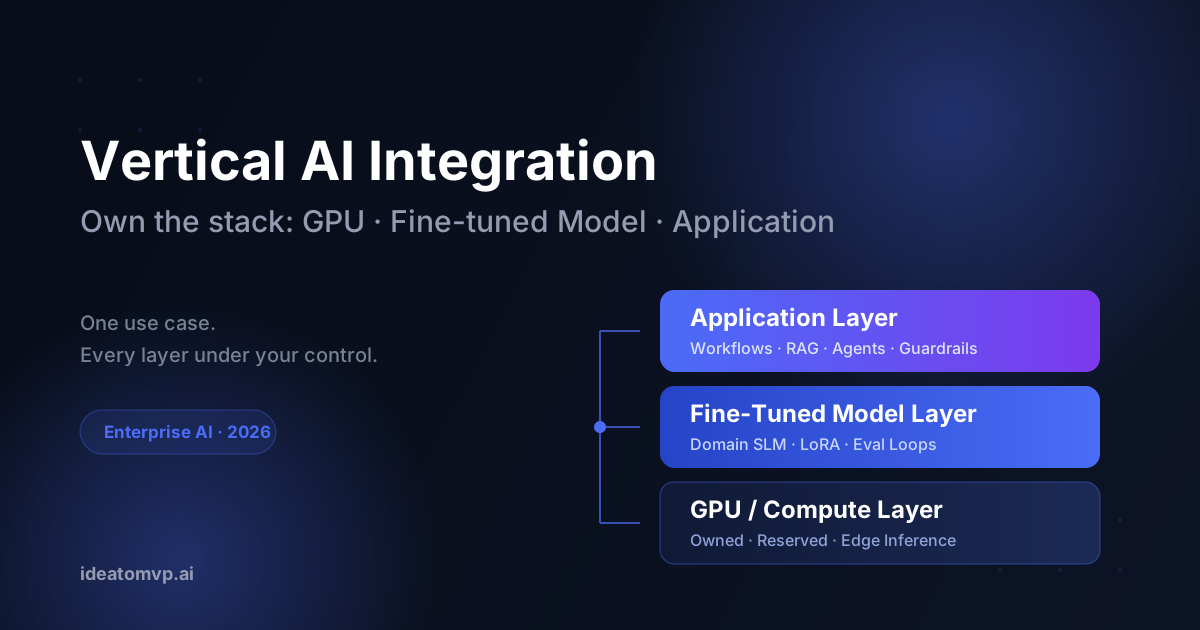
Vertical AI integration — GPU, fine-tuned model, and application layers

For the last three years, the default enterprise AI architecture has been horizontal: rent a frontier model through an API, wire it into a dozen workflows, and pay per token. It was fast to start and expensive to stay. In 2026, the largest and most operationally serious enterprises are quietly doing the opposite — vertically integrating their AI stack, one layer at a time, around the use cases that actually move their P&L.

Vertical integration in AI means the same thing it meant for Ford and steel or Apple and silicon: owning the layers of your value chain that create differentiation, instead of renting them from a supplier who also serves your competitors. In AI, those layers are three: the compute (GPU) layer, the model layer, and the application layer. This article walks through each one, why the integration math finally works, and the sequencing that lets an enterprise make the transition without betting the company.

Why Vertical Integration, and Why Now

Three forces converged to make owning the stack rational for enterprises that would have laughed at the idea in 2024.

  • API costs stopped scaling with value. Enterprises running AI in production workflows report five- and six-figure monthly API bills where most tokens are spent on repetitive, narrow tasks — classification, extraction, summarization — that do not need a frontier model at all. Paying frontier prices for commodity inference is the AI equivalent of running batch jobs on premium on-demand cloud instances.
  • Open-weight models closed the quality gap on narrow tasks. A fine-tuned small model, trained on your own labeled data, now routinely beats a prompted frontier model on the specific task it was trained for — at a fraction of the latency and cost. The gap only matters on open-ended reasoning, which is a minority of enterprise workloads.
  • Data sovereignty became a board-level issue. Regulated industries — healthcare, finance, defense, legal — increasingly cannot send their most valuable data to a third-party API, full stop. The choice is not "rent vs. own"; it is "own or don't deploy."

The strategic logic is the same one Palantir's Alex Karp has been hammering publicly: control your compute, your model weights, and your data, or watch the value of your proprietary knowledge leak into someone else's training run. Vertical integration is how that principle becomes an architecture.

Layer 1: The GPU / Compute Layer

Owning the compute layer does not mean building a data center. It means moving from per-token pricing to capacity you control, in whichever form fits your scale:

  • Reserved GPU cloud — committed A100/H100 capacity from providers like CoreWeave, Lambda, or the hyperscalers' reserved tiers. The entry point for most enterprises: predictable cost, no capex, no ops team for hardware.
  • Owned inference hardware — a small rack of L40S or RTX-class cards for steady, latency-sensitive inference. A single modern GPU serves a fine-tuned 7B model to hundreds of concurrent users; the hardware pays for itself against API bills in months, not years.
  • Edge inference — quantized models running on-premises or on-device where data cannot leave the building: hospital networks, factory floors, trading desks.

The decision rule is utilization. If your inference volume is steady and predictable, owned or reserved capacity wins. If it is spiky and experimental, stay on rented compute for that workload and integrate the steady ones first.

Layer 2: The Fine-Tuned Model Layer

This is the layer where vertical integration creates a moat. A frontier API gives every competitor the same intelligence at the same price. A model fine-tuned on your transaction history, your support conversations, your contracts, your defect reports — that is intelligence only you have.

The modern fine-tuning pipeline is dramatically lighter than most executives assume:

  • Base model selection — start from an open-weight model (Llama, Phi, Gemma, Mistral) sized to the task. Most enterprise tasks land in the 3B–8B range.
  • Parameter-efficient training — LoRA and QLoRA adapt a base model with thousands of examples on a single GPU in hours. Data curation, not compute, is the real work: the quality of your labeled examples decides the quality of the model.
  • Evaluation loops — a held-out test set scored on your actual business metric, run on every retrain. This is the discipline that separates production model programs from science projects.
  • Retraining cadence — monthly or quarterly retrains on fresh production data. Each cycle widens the gap between your model and anything a competitor can prompt-engineer.

The integration test for the model layer

Ask one question: does this task benefit from knowledge only we have? If yes, fine-tune and own it. If no — if a generic model prompted well does the job — keep renting that task and spend your training budget where your data is the advantage.

Layer 3: The Application Layer

The application layer is where the model meets the business, and it is the layer enterprises most often get wrong — either by leaving it to a SaaS vendor (and losing the workflow along with the data) or by underinvesting in it relative to the model. A vertically integrated application layer includes:

  • Serving infrastructure — vLLM or TGI for high-throughput inference, with structured-output enforcement so downstream systems receive valid JSON, not prose.
  • Retrieval (RAG) over your own knowledge — your documents, embedded and indexed on your infrastructure, so the model answers from your ground truth rather than its training data.
  • Intelligent routing — the pragmatic heart of the stack. Route 70–80% of requests to your fine-tuned model; escalate the genuinely hard, open-ended 20–30% to a frontier API. Vertical integration is not purity — it is putting each request on the cheapest layer that handles it well.
  • Guardrails and audit — input/output filtering, PII handling, and full request logging. When you own the stack, compliance stops being a vendor questionnaire and becomes a property of your architecture.

The Sequencing: How Enterprises Actually Make the Move

No enterprise vertically integrates everything at once. The pattern that works runs top-down — the opposite of how the stack diagram reads:

  • Own the application layer first. Build your workflows, retrieval, and routing on rented frontier APIs. This is where you learn what your real request distribution looks like — which is the data you need for every later decision.
  • Integrate the model layer for your highest-volume task. Pick the single workload burning the most API spend, fine-tune a small model for it, and swap it behind the router. Measure quality and cost against the API baseline.
  • Integrate compute once utilization justifies it. When your self-hosted inference is steady, move it from on-demand GPU cloud to reserved or owned capacity and lock in the cost floor.

Each step is independently justified by its own ROI, and each step is reversible. That is what makes this a strategy rather than a bet.

When Not to Integrate

Vertical integration is wrong for you if your AI workloads are still exploratory, if you lack the labeled data that makes fine-tuning worthwhile, or if your core tasks genuinely require frontier-scale reasoning and broad world knowledge. In those cases the rented stack is not a trap — it is the correct tool. The mistake is staying on it by default after your workloads have become narrow, steady, and data-rich.

The Bottom Line

The enterprises winning with AI in 2026 are not the ones with the biggest API budgets. They are the ones that identified their highest-value, highest-volume use case and integrated the stack underneath it — application logic they control, a model trained on data only they have, running on compute priced like infrastructure instead of a metered utility. Start at the top of the stack, move down one layer at a time, and let each layer's ROI fund the next.

If you are weighing where to start —which workload to fine-tune first, or whether your volume justifies owned compute — book a free discovery call and we will map your stack with you.

Share this post :

Related Posts

The Vertical SLM Stack: GPU, Training, and Application Layer for Domain-Specific AI in 2026July 6, 2026
Claude Code /loop Command: How to Use It for Smarter Coding Workflows in 2026July 3, 2026
Why AI Is Hard: The Real Problems Founders Hit After the Demo WorksJuly 1, 2026